Introduction: Selecting the Right Signage Materials for Stress-Free Convention Travel
Flying into Las Vegas with a packed schedule leaves little room for bulky displays. When choosing travel-friendly signage materials, most exhibitors compare foamcore vs corrugated plastic signs because both deliver lightweight trade show signage without complicated hardware. The right pick depends on how you’ll transport pieces, how they’ll be used on-site, and how much handling they’ll endure between sessions.
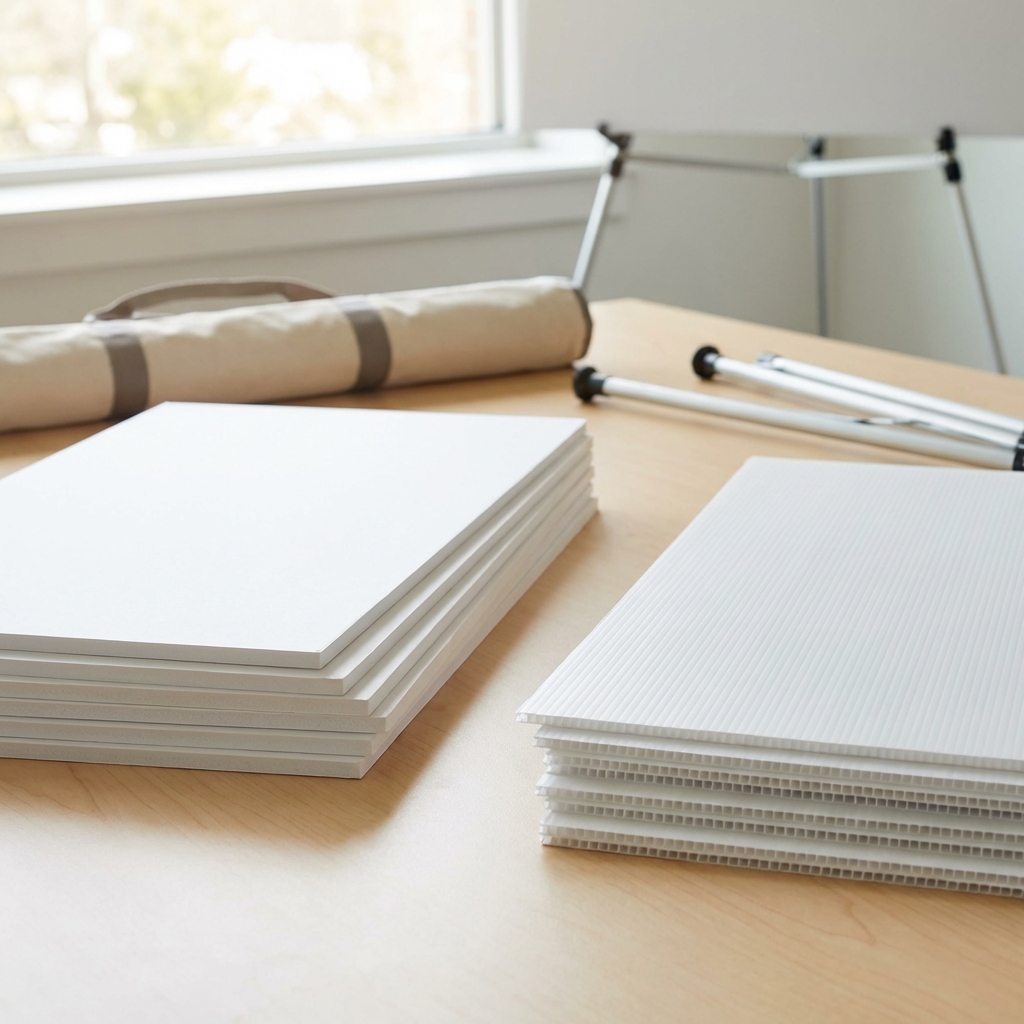
Foamcore (foam board) offers a smooth, premium print surface that makes colors and fine type look crisp—ideal for sponsor boards, agendas, photo backdrops, and tabletop displays. It’s very light and rigid, especially in 3/16″ thickness for portable event graphics, but edges can dent and panels can crease if packed loosely. Foamcore is best for indoor, short-term use; consider corner protectors, slip sleeves, or easel backs to keep panels clean and upright. If you plan to hand-carry in a portfolio or carry-on, foam board’s finish and stiffness make setup fast and polished.
Corrugated plastic (coroplast) is tougher for travel and repeat use, thanks to its fluted polypropylene construction. It resists moisture, wipes clean, and tolerates bumps in transit—useful for registration counters, outdoor queues, or signage that gets moved between rooms. While slightly more flexible than foam board at 4mm, coroplast supports grommets, zip ties, and hook-and-loop mounting for durable convention displays. For portable event graphics that may be checked in luggage or shipped, coroplast versus foam board often wins on durability and longevity.
Use this quick checklist to decide:
- Transport plan: Will you carry on, check, or ship to the venue?
- Mounting method: Easel, wall, pipe-and-drape, magnet, or hanging with grommets?
- Environment: Strictly indoor, or exposure to lobbies, patios, or rideshares?
- Lifespan: One-and-done messaging or reusable show-to-show assets?
- Size constraints: Panels over 24″ x 36″ may need scoring, hinges, or split sets to pack safely.
Design One Printing helps simplify the choice with same-day and next-day production near the Strip, direct-UV printing on foam board and coroplast, grommets and easel backs, and hotel or venue delivery. If you’d rather travel light, have your files produced on arrival through their Las Vegas convention printing solutions. Their team can also advise on protective packaging, double-sided panels, and hardware so your travel-friendly signage materials arrive on time and look the way you envisioned.
Exploring Foamcore: High-End Aesthetics for Professional Indoor Displays
If you’re weighing foamcore vs corrugated plastic signs for a Las Vegas convention, foamcore delivers the premium, gallery-like finish that elevates indoor branding. The paper-faced surface prints with rich color and smooth detail, avoiding the plastic sheen sometimes seen with coroplast. For sponsor boards, directional signage, product snapshots, and executive presentations, foamcore reads polished and professional while remaining light enough for quick setup.
Common thicknesses are 3/16″ for most easel and wall-mounted displays and 1/2″ when you need extra rigidity for larger panels like 30″x40″ or 36″x48″. Direct UV printing keeps lines crisp; adding matte lamination reduces glare under trade show lighting and adds scuff resistance. Mount with Command strips, Velcro, or slide into sign frames; easel backs make tabletop or lobby placements effortless for lightweight trade show signage and portable event graphics.
Choose foamcore when:
- You want a premium look for indoor panels and photo-heavy layouts
- Displays will be viewed up close (registration counters, demo stations, press rooms)
- You need contour-cut logos or shapes for an elevated brand presentation
- You’re installing on easels or walls for 1–3 days of show use
Foamcore is less forgiving for travel than coroplast; edges can dent and the paper face can crease. For travel-friendly signage materials, request corner protectors, ship in foam-lined cartons, and consider matte lamination. If your schedule involves repeated pack-in/pack-out, coroplast versus foam board favors coroplast for durability and moisture resistance. A middle ground is gator board (denser facers) for more durable convention displays without sacrificing a refined look.
Design One Printing produces same-day foamcore panels, contour cuts, easel backs, and matte or gloss laminates—ideal when you land in Las Vegas and need signage within hours. Located minutes from the Strip, the team can also recommend when to switch to coroplast for hard-wearing usage and handle color-critical file prep; see their guide to professional large format printing before you upload artwork. For turn-key convenience, they can print, pack, and deliver directly to your hotel or convention dock.
The Benefits of Corrugated Plastic: Exceptional Durability for Rigorous Transport
When it comes to foamcore vs corrugated plastic signs, corrugated plastic (often called Coroplast) wins for road‑warrior reliability. Its twin‑wall polypropylene build shrugs off bumps, corner dings, and compression that would crease or delaminate paper‑faced foamcore. It’s also moisture‑proof, so a quick drizzle at the loading dock or a spilled drink en route won’t ruin your print.
Convention travel is rough: freight docks, rideshares, hotel bell carts, and repeated setups. Corrugated plastic absorbs impact, resists edge crush, and wipes clean of scuffs, making it ideal for portable event graphics that may be handled by multiple crews. UV‑direct printing and optional laminate add abrasion resistance for multi‑day shows. In contrast, foamcore is best left for controlled, short‑term indoor displays where handling is minimal.
For travel-friendly signage materials, these properties matter most:

- Impact and crush resistance for repeated handling
- Waterproof, wipeable surfaces for quick cleanup
- Lightweight rigidity that packs flat without bowing
- Compatibility with grommets, zip ties, Velcro, and easel backs
- Reusable panels that stack without edge fray
Hardware flexibility is another advantage. Corrugated plastic accepts grommets for hanging from pipe‑and‑drape, zip ties and bungees for truss, and double‑sided tape or hook‑and‑loop for walls and podiums. It can be contour‑cut for shaped logos, scored to form table tents or fold‑flat A‑frames, and printed double‑sided for aisle‑facing messages. Choosing flute direction helps prevent sag in wide panels and ensures clean edges when inserting stakes or brackets.
Despite its toughness, corrugated plastic remains lightweight trade show signage, simplifying shipping and carry‑on transport. Common thicknesses include 4 mm for hanging panels and inserts, 6 mm for larger backwall tiles, and 10 mm for freestanding sign faces. It tolerates the desert heat and dry air typical of Las Vegas venues far better than paper‑faced boards, helping you maintain crisp, durable convention displays across multiple activations.
Design One Printing produces same‑day coroplast versus foam board solutions for exhibitors who can’t risk damage in transit. Our UV flatbed printing, grommeting, flute orientation guidance, contour cutting, and hotel delivery near the Las Vegas Strip make setup seamless. If you need rugged, travel‑ready panels that still look polished, corrugated plastic from Design One Printing is the smart choice.
Portability Comparison: Handling and Weight Factors for Event Staff
When comparing foamcore vs corrugated plastic signs for portability, both are light enough for one person to carry multiple pieces at once. Standard 3/16-inch foam board is slightly lighter per square foot, while 4mm coroplast is marginally heavier but still firmly in the lightweight trade show signage category. For staff walking hotel corridors or navigating the Las Vegas Convention Center, the practical difference in carry weight is small; handling and durability matter more.
Foam board’s stiffness keeps panels flat and professional on an easel, but its paper faces and soft edges dent easily during load-in, re-staging, and teardown. Coroplast’s fluted polypropylene structure flexes a bit, shrugging off corner bumps, light moisture, and repeated trips in a cart or rideshare. If a team is shuttling portable event graphics between offsite meetings or reusing signage across multiple days, coroplast often outlasts foam without babying.
Attachment and transport also influence portability. Foam board pares well with easel backs and low-tack wall tabs; it’s not ideal for grommets or zip ties. Coroplast accepts grommets and can be secured to pipe-and-drape, stanchions, or pole pockets, and can be scored to fold for easier packing—useful when moving 24×36 wayfinding arrows through crowded lobbies. At larger sizes (36×48 and up), foam board’s snap risk increases, while coroplast’s slight flex reduces the chance of breakage in elevators and back-of-house corridors.
Quick picks and handling tips for travel-friendly signage materials:
- Single-day indoor announcements: 3/16-inch foam board for the lightest carry and crisp, flat presentation.
- Multi-day or outdoor-adjacent use: 4mm–6mm coroplast for durable convention displays that resist dings and humidity.
- Mounting: Foam board for easels; coroplast for grommets, zip ties, and frames.
- Packaging: Ask for corner protectors, slip sheets, and labeled sets; keep stacks under 10 pieces to prevent edge crush.
- Transport: Use flat shipping cartons; consider coroplast if flying in, as it tolerates handling better than foam.
Design One Printing, minutes from the Strip, can advise on coroplast versus foam board based on your venue and schedule, then produce same-day sets kitted by room or session. Our team can add easel backs, grommets, and Velcro tabs, and deliver pre-boxed bundles directly to your hotel dock—so event staff spend less time juggling signs and more time running the show.
Visual Impact: Print Quality and Finish Differences Between Materials
On a busy expo floor, visual clarity and finish are everything. When comparing foamcore vs corrugated plastic signs, both qualify as lightweight trade show signage, but their surfaces render color and detail differently. The choice affects how your brand photographs, how easily text reads at a distance, and how the piece holds up under harsh convention lighting.
Foam board (foamcore) has a smooth, paper-faced surface that produces crisp, photo-quality results. Fine type, gradients, and skin tones reproduce cleanly, making it ideal for product beauty shots, sponsor boards, and executive portraits. Matte or satin finishes control glare from overhead LEDs, while a gloss laminate can add pop for retail-style visuals. The edge profile looks clean and “gallery-like,” though the paper face can scuff if handled roughly or exposed to moisture.
Corrugated plastic (coroplast) is a fluted polypropylene with a subtle texture that’s excellent for bold, high-contrast graphics. Direct-UV printing yields vibrant color, but the flute pattern can soften ultra-fine details and thin hairlines at close range; it shines with larger typography and solid fills. The material is waterproof and more resistant to dings, so the print appearance stays consistent through setup, takedown, and shipping. Expect a semi-gloss look by default; matte or gloss laminates can fine-tune glare and color saturation.
Use these cues to align finish with intent for portable event graphics and durable convention displays:
- Photographic panels and sponsor walls: foam board with matte or satin laminate for natural skin tones and reduced glare.
- Directional and schedule signage: coroplast with larger type for readability and durability in high-traffic areas.
- Backlit or spotlighted booths: foam board with matte laminate to prevent specular highlights in photos.
- Outdoor or shuttle-area messaging: coroplast, optionally with UV laminate, for weatherproof performance.
- Travel-friendly signage materials: coroplast can be scored for folding or outfitted with grommets; foam board favors clean edges and easel stands.
Design One Printing helps you navigate coroplast versus foam board with on-site material swatches, color-managed proofs, and finish recommendations tailored to the Las Vegas Convention Center and Strip venues. Need it fast? Same-day production, contour cutting, double-sided prints, and lamination ensure your portable event graphics look sharp and arrive on time.

Environmental Factors: Performance in High-Traffic Trade Show Environments
Las Vegas convention floors are crowded, fast-moving, and hard on graphics. Signs get brushed by attendees, nudged by carts, and relocated multiple times during install and show hours. Spills, HVAC drafts, and overnight cleaning add more variables. In these conditions, the real-world differences in foamcore vs corrugated plastic signs become obvious.
Foamcore delivers a premium, smooth surface that photographs well and reduces glare, making it ideal for sponsor boards, press backdrops, and product feature panels in protected areas. However, its paper facings can scuff, the edges crush easily, and moisture can cause warping or delamination. It performs best as lightweight trade show signage mounted on easels behind tables, set on reception counters, or temporarily adhered to walls where traffic is controlled.
Corrugated plastic (Coroplast) is engineered for abuse: it’s waterproof, wipeable, and more impact-resistant, so bumps and occasional drops are rarely fatal. The fluted polypropylene core resists edge crush and holds up during frequent moves, loading dock transfers, and overnight resets. For wayfinding, safety notices, and portable event graphics near aisle lines or entrances, coroplast versus foam board typically wins on durability. Choose 4mm for hand-held or short-term placements and 6mm for larger, freestanding panels with less flex.
Mounting and handling considerations in high-traffic environments:
- Pipe-and-drape and truss: Coroplast with grommets/zip ties resists tearing; foamcore can rip at puncture points.
- Floor stands and stanchions: Coroplast tolerates bumps; foamcore needs careful placement and thicker stock to reduce bowing.
- Wall applications: Foamcore offers a clean, flush look with removable tape; test adhesives to prevent paper tear-out on removal.
- Cleaning and spills: Coroplast can be wiped down; foamcore should be kept off floors and away from food stations.
If you plan to re-use signs across multiple days or shows, coroplast is the more travel-friendly signage material. It nests in shipping cases without corner guards and tolerates rough handling better. Foamcore can still be viable for single-use, premium panels when packed with edge protection and handled by a dedicated install crew. Always confirm venue rules—some installations may specify hardware, placement, or fire-safety documentation.
Design One Printing helps teams choose the right substrate for durable convention displays, then outfits each piece with the correct thickness, matte or anti-glare laminate, grommets, or easel backs. Located minutes from the Strip, we produce both materials same day and deliver directly to major venues, reducing downtime when plans change onsite.
Conclusion: Selecting the Optimal Substrate for Your Brand’s Traveling Needs
When weighing foamcore vs corrugated plastic signs, start with how far your materials will travel, how long they must last, and how polished they need to look under show lighting. Both are lightweight trade show signage options, but they behave very differently once you’re packing, mounting, and moving them across venues. Think in terms of finish quality, durability under handling, and how you’ll display them on-site.
Foamcore excels for short-term, indoor visuals that need a refined, photo-smooth surface. It’s ideal for registration backdrops, tabletop displays, and product feature boards where color fidelity and crisp type matter, especially in 24″ x 36″ or 30″ x 40″ formats. In the coroplast versus foam board comparison, foamcore’s paper-faced surface prints beautifully but dings easily; plan on easel backs or Command Strips and careful packing if you’re hopping between sessions.
Corrugated plastic (Coroplast) is the workhorse for durable convention displays and multi-day programs. The fluted polypropylene (typically 4 mm, with 6–10 mm for larger panels) resists moisture, cleans up with a wipe, and stands up to zip-ties, grommets, H-stakes, and repeated handling. It’s the safer bet for shipping cases, checked baggage, or quick rigging to pipe-and-drape, and it’s great for double-sided portable event graphics.
Quick picks to decide fast:
- Travel and handling: flying in light or rideshare to the LVCC? Coroplast is more travel-friendly signage materials; foamcore is fragile in overhead bins.
- Mounting method: foamcore pairs with easels or wall-safe strips; coroplast takes grommets, zip-ties, and stake hardware.
- Visual finish: foamcore offers the smoothest, premium look; coroplast can show subtle flute lines on close inspection.
- Size and thickness: foamcore commonly 3/16″; coroplast standard 4 mm—size up thickness for 36″ x 48″+.
- Budget and reuse: coroplast often edges out on cost-per-use and longevity; foamcore shines for one-off, high-polish moments.
If you’re still torn, Design One Printing can spec, print, and deliver both substrates same-day, minutes from the Las Vegas Strip. Our team tunes recommendations to your booth plan—adding grommets, easel backs, edge protection, and matte or gloss lamination—then coordinates drop-off to Las Vegas Convention Center, Mandalay Bay, Venetian Expo, and more. You’ll get portable event graphics that arrive on time, look sharp, and survive the show.
Contact us today at designoneprinting.com to see how we can help on your next project.