1. Target Your Ideal Neighborhood with Precision EDDM Delivery
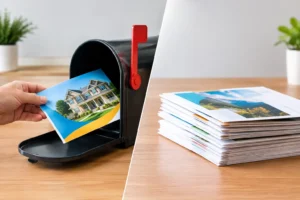
Every Door Direct Mail (EDDM) postcards are one of the most reliable ways to reach customers right in your neighborhood. Unlike digital ads that get scrolled past, a physical postcard in someone’s mailbox gets noticed. But here’s the challenge: if your postcard doesn’t stand out or reach the right people, you’re throwing money at something that won’t deliver results.
We’ve helped hundreds of Las Vegas businesses and event organizers launch successful EDDM campaigns. The difference between a campaign that generates real leads and one that gets tossed with the junk mail? Strategy. We’re walking you through seven proven tactics that’ll turn your postcard printing into a growth engine for your business.
EDDM sounds simple: you mail to every address in a ZIP code or carrier route. But the smart move is picking exactly which neighborhoods match your ideal customer. This is where your campaign either works or wastes budget.
Start by mapping where your best customers currently live or work. If you run a dental practice in Henderson, don’t blanket all of Las Vegas. Focus on specific neighborhoods within 3-5 miles of your location. If you’re a contractor targeting high-value home renovation markets, EDDM to affluent residential areas where homeowners are more likely to invest in your services.
USPS lets you target by ZIP code, carrier route, and even specific delivery sectors. Take advantage of that precision. You’re not paying for postcards reaching people who’ll never buy from you. You’re investing in reaching neighbors who actually fit your customer profile.
What to do next: Pull your current customer addresses and identify geographic clusters. Cross-reference those clusters with EDDM coverage maps from USPS. Start there, then expand methodically based on results.
2. Design High-Converting Postcards That Stand Out in Mailboxes
A postcard sitting in someone’s mail pile has about two seconds to make an impression before it gets recycled. Your design has to earn attention immediately.
The best postcards follow a simple formula: strong visual hierarchy with one clear focal point, crisp photography or graphics, plenty of white space, and messaging that speaks directly to a specific need. Don’t cram twelve product photos and five paragraphs onto a 4×6 card. Clutter kills conversions.
Consider your front side as real estate. Feature a high-quality image of your best work or your core offer. Make it visually compelling enough that someone stops and looks. The back is your story: headline, brief benefit statement, call-to-action, and contact information. Keep copy tight and benefit-focused, not feature-heavy.
If you’re offering a service (HVAC repair, salon services, tax consulting), show the result, not the process. A homeowner cares about a comfortable home, not your technical toolkit. A salon client cares about walking out looking amazing, not the brand name of the shampoo.

We work with businesses daily to translate their brand into postcards that actually get responses. Good design isn’t flashy. It’s clean, on-brand, and purposeful.
What to do next: Grab three postcards from services you actually use and study them. Which ones caught your eye? What made you pause? That’s your design cue.
3. Choose Durable, Premium Postcard Stock for Maximum Impact
A flimsy, thin postcard feels cheap and gets tossed without a second thought. Premium stock matters more than people realize.
We recommend 14-16 point cardstock for EDDM campaigns. It’s substantial enough to feel valuable in someone’s hands, durable enough to survive the mail system without bending or creasing, and thick enough that recipients treat it as something worth keeping (even if just for a few minutes).
Matte finish is typically your best bet for readability and a professional look. It reduces glare, feels premium, and photographs don’t look washed out. Gloss finish works if you’re featuring vibrant product photography, but it can feel plastic-y if overdone.
Don’t skimp on materials. A postcard printed on flimsy stock undermines your entire message, no matter how good your design is. You’re telling your neighbor, “We cut corners,” even if you don’t mean to. Premium stock says, “We invested in this because we respect your time.”
What to do next: Request sample packs from your printer. Feel the difference between 11-point and 14-point stock in person. You’ll understand immediately why the heavier option converts better.
4. Leverage Eye-Catching Colors and Compelling Headlines
Color psychology in direct mail is real. Your postcard needs to stand out in a stack of mail, and the right color combination makes that happen.
Avoid bland, corporate grays and tans. Bold, contrasting colors catch the eye fast. Bright blues paired with white, deep greens with gold accents, or vibrant oranges with charcoal work well depending on your brand. Test what matches your identity without looking generic.
Your headline is equally critical. It should immediately answer, “Why does this matter to me?” Not “Quality Carpentry Services Available” but “Your Kitchen Renovation Starts Here” or “Stop Paying for AC Repairs You Don’t Need.” The difference is emotional resonance. People react to outcomes and solutions, not generic service descriptions.
Use numbers when they strengthen your case. “Get 30% off your first cleaning” pulls better than “We offer special discounts.” Specificity builds credibility. “Join 2,000+ satisfied clients” beats “Many customers love us.”

What to do next: Write three different headlines for your postcard and test them with five people who match your target customer. Which one makes them actually want to read more? Lead with that.
5. Include Strong Calls-to-Action That Drive Immediate Response
A gorgeous postcard with no clear next step is wasted effort. Your call-to-action (CTA) should be unmissable and make it effortless to respond.
The best CTAs are specific and urgent without being pushy. Instead of “Contact us,” try “Claim your free estimate today” or “Book your appointment before Friday.” Instead of “Visit our website,” make it “Get our free kitchen design guide at [your URL]” or “Text KITCHEN to 12345 for instant savings.”
Include every relevant contact method: phone number, website URL, text line if you support it, or even a QR code. People have different preferences. One person will call. Another will text. A third prefers visiting your site. Remove friction by offering all of them.
Offer something of immediate value. A postcard promising “Call for details” converts worse than one offering “Get a free estimate” or “Receive 20% off your first service.” Give them a reason to respond right now, not someday.
What to do next: Identify the single most valuable action you want someone to take (a phone call, a website visit, a text message). Make that one CTA stand out visually and in messaging. Test different incentives (discount, free service, limited-time offer) across batches if possible.
6. Time Your EDDM Campaigns with Local Events and Seasons
Timing dramatically impacts response rates. An HVAC cleaning postcard will pull better in early spring or late fall when people are thinking about seasonal maintenance. A tax service postcard lands better January through March. A moving company postcard gets response when people are actually relocating.
Las Vegas has unique seasonal patterns. Convention season (January through June, with peaks around CES, NAB, and other major shows) means increased foot traffic and transient populations. Summer heat spikes create demand for cooling services. Holiday shopping season drives retail promotions. Align your postcard timing with when your target customer is most actively seeking your service.
If you’re reaching event planners or convention exhibitors, time your campaign around major Las Vegas trade shows. If you’re a local business, hit neighborhoods during seasonal buying windows or right before major holidays when people are spending.
We’ve seen EDDM campaigns pull 2-3x better when timing matches customer intent. Planning a postcard push? Map it to when your market is actively buying.

What to do next: List your three busiest business seasons. Plan EDDM campaigns to drop two weeks before peak demand. Mail typically delivers within 3-10 days, so factor that into your timeline.
7. Track Results and Optimize Your Next Campaign
Without tracking, you’re flying blind. You don’t know what worked, what flopped, or where to invest next.
Create a system to measure response. Use a unique phone number or promo code on each postcard batch so you can track calls and conversions by campaign. If you’re running multiple postcards to different neighborhoods or with different designs, code each one so you know which pulled the best response rate.
Ask every customer, “How did you hear about us?” when they call or convert. Build that question into your contact forms if people respond online. Over time, you’ll see patterns: maybe postcards pulled better than you expected in ZIP code 89109 but underperformed in 89123. Maybe the design with the bold red background crushed it compared to the subtle blue version.
EDDM response rates vary widely by industry and audience, but expect 0.5% to 2% as a realistic range. If you’re pulling 2% (2 responses per 100 postcards), that’s solid. At 4% to 5%, you’ve found gold and should scale up immediately.
After your first campaign, review the numbers and refine. Change one variable at a time: test a different neighborhood, a new headline, a different color scheme. Methodical testing beats guessing.
What to do next: Before your next EDDM drop, set up tracking codes and a response measurement system. Decide now how you’ll know if the campaign works. Track everything. Your second campaign will be twice as effective because you’ll know exactly what resonated.
—
EDDM postcard printing is a proven channel for local business growth, but only when you execute it strategically. We’ve walked you through targeting the right neighborhoods, designing postcards that convert, choosing materials that feel premium, leveraging color and headlines, crafting irresistible CTAs, timing campaigns for maximum impact, and building in measurement and optimization.
At Design One Printing, we handle EDDM campaigns for Las Vegas businesses and event professionals every week. We know how to print postcards that don’t just look sharp but actually pull responses. From design consultation to EDDM-ready production to delivery coordination, we handle the entire process so you can focus on converting leads into customers. If you’re ready to launch a postcard campaign that actually works, send us your details and we’ll dial in a quote that fits your budget and timeline.
For further reading: EDDM vs Direct Mail.
Contact us today at designoneprinting.com to see how we can help on your next project.