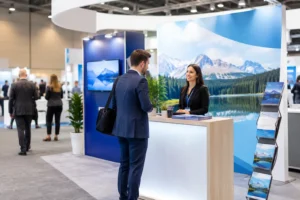
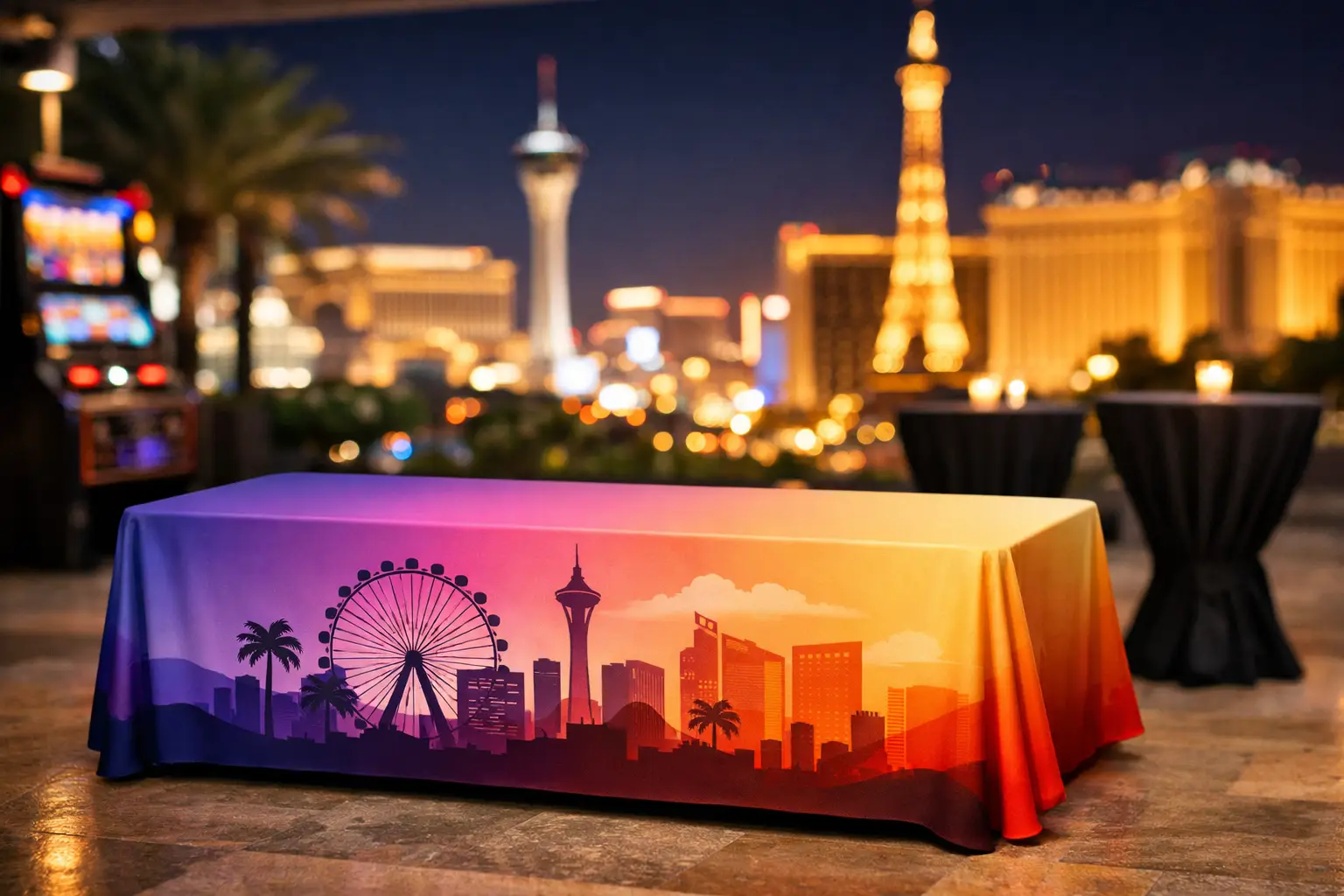
A bare six-foot table can make even a well-built trade show booth look unfinished. Custom table throw printing turns that table into a branded presentation surface, giving attendees a clear view of your company before they pick up a brochure or start a conversation. For Las Vegas exhibitors working in busy convention halls, that visual consistency helps a compact booth look organized, credible, and ready for business.
A printed table throw is not simply a logo placed on fabric. The size of the table, the type of fabric, the placement of your artwork, and the production timeline all affect the finished result. Making those decisions early can prevent common issues such as hidden logos, undersized graphics, or a throw that does not fit the table on the show floor.
Why a Custom Table Throw Earns Its Space at Your Booth
Trade show tables tend to become command centers. They hold product samples, lead forms, tablets, giveaways, literature, and personal items your team needs during the day. Without a table throw, all of that activity sits against a plain or mismatched background.
A professionally printed throw creates a clean foundation beneath the materials. It can carry your logo, brand colors, campaign message, website, or a simple call to action while concealing boxes and supplies stored under the table. That combination of branding and function is especially useful for smaller exhibit spaces where every visible surface needs to work harder.
Table throws also travel well. Unlike a rigid sign or large display wall, fabric throws fold down for transport and can be used repeatedly at conventions, networking events, job fairs, pop-up retail activations, hotel meetings, and community events. If your organization attends several events each year, a versatile branded throw often becomes one of the most practical pieces in your event kit.
Choosing the Right Table Throw Style
The standard choice is based on the length of your table. Six-foot and eight-foot tables are common at trade shows, but dimensions can vary slightly by venue. Confirm the assigned table size with the event organizer before approving production. A six-foot throw on an eight-foot table will look short and may leave the ends exposed.
Full Throws for Maximum Coverage
A full table throw covers the top, front, sides, and back of the table. This is a strong option when your booth may be viewed from multiple directions or when you want complete coverage for supplies underneath. Full throws are also useful for events held in open ballroom layouts where guests can move behind your display.
The trade-off is access. If your team needs to reach storage items beneath the table frequently, lifting the back panel can become inconvenient. For product demonstrations or check-in stations, a different construction may be more practical.
Open-Back Throws for Working Booths
An open-back table throw provides a finished front and side presentation while leaving the rear open. It gives staff easier access to boxes, extra collateral, and equipment stored below the tabletop. For most exhibitor booths where attendees approach from the front and team members work from behind, this is often the most functional choice.
An open back does not look unfinished when the table is positioned against a backdrop, wall, or booth structure. If the back of the table will be visible to attendees, however, a full throw may offer a more polished result.
Fitted and Stretch Styles
Fitted throws have shaped corners that follow the table’s form, creating a tailored appearance. Stretch styles pull tightly around the table legs for a smooth, modern look. Both can be effective for brands that prefer crisp lines and minimal visual movement.
These styles depend on accurate table dimensions. They also offer less flexibility if a venue substitutes a different table model. A traditional draped throw is more forgiving and generally works well across a range of event settings.
Build Artwork for the Front View
The front panel is the primary branding zone. It should communicate who you are from several feet away, not require attendees to stand directly in front of the table to understand it. A large, high-resolution logo centered on the front panel is often the best starting point.
Avoid treating the table throw like a flyer. Long paragraphs, small service lists, and dense contact information are hard to read when fabric drapes over the front of a table. If your booth needs to communicate a specific promotion, use a short headline or a few bold words paired with the logo. Your banner, backdrop, handouts, or digital display can carry the supporting details.
Keep essential artwork away from edges, seams, and the lower portion of the front panel. The fabric may fold, gather, or be partially blocked by products and chairs. Side panels are useful for secondary branding, but they should not carry the only version of your logo or message.
For best print quality, provide vector logo files when available, such as AI, EPS, or print-ready PDF files. High-resolution raster files can also work if they are large enough for the final print size. A small image copied from a website may look acceptable on a screen but become soft or pixelated when enlarged across a table throw.
Color and Fabric Matter More Than They Seem
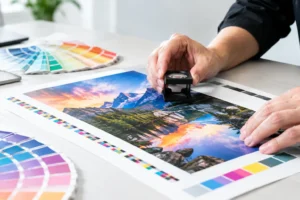
Fabric printing allows for vivid full-color graphics, gradients, photos, and edge-to-edge background colors. Still, the design should account for the environment where it will be used. Las Vegas convention center lighting can be bright, and exhibit halls are full of competing visual messages. High contrast typically reads better than subtle color-on-color treatment.
A white logo on a deep brand color can create a strong, clean look. Dark text on a light background can work just as well. What matters is legibility from a distance. If your brand palette includes several similar shades, choose the combination with the clearest contrast for the main logo and headline.
Fabric type affects appearance and maintenance. Polyester materials are popular because they are lightweight, durable, and suited to full-color dye-sublimation printing. They also tend to resist wrinkling better than many alternatives, though any folded fabric can develop creases during travel. Plan to unpack the throw ahead of setup, and follow the recommended care instructions before the event.
Plan Your Custom Table Throw Printing Timeline
Event deadlines become real fast in Las Vegas. A booth assignment changes, a sponsor logo is updated, or a last-minute marketing campaign requires new graphics. While rush production may be possible depending on the material, print method, finishing, and current schedule, custom fabric items should not be treated as an afterthought.
Give yourself time for three steps: confirming table dimensions, preparing final artwork, and reviewing the proof. The proof is where you can verify logo position, spelling, colors, and whether the selected style is open-back, full-back, fitted, or stretch. Approving a proof carefully is faster than correcting a completed item under a deadline.
If your event is approaching quickly, contact your print partner with the event date, required delivery date, table size, and artwork status immediately. Clear information helps the production team identify realistic options and avoid wasted time. A local provider can also be valuable when you need to coordinate pickup, make artwork adjustments, or replace a missing event graphic close to show time.
Make the Throw Part of a Complete Exhibit System
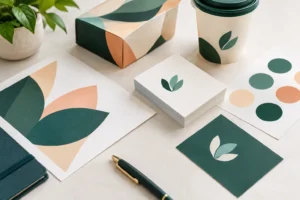
The strongest booth presentations repeat a few visual elements rather than putting different messages on every item. Your table throw should align with your retractable banner, backdrop, brochures, business cards, signs, and product packaging. Matching colors and logo treatment makes the entire space feel intentional, even when the booth footprint is modest.
Consider how people will interact with the table. If you are collecting leads, leave a clear area for the form or tablet. If you are displaying products, avoid covering the front panel with tall stacks of materials. If your team will sit behind the table, bring branded or neutral seating when possible so mismatched furniture does not distract from the presentation.
Design One Printing helps Las Vegas businesses and exhibitors prepare coordinated event materials on demanding schedules, from table throws and banners to brochures, signs, and last-minute display graphics. A quick conversation before production can help determine whether your artwork needs adjustment for fabric printing and whether your event setup calls for full coverage or easy rear access.
When the show floor opens, your table should not be the place where branding disappears behind boxes and loose supplies. Choose a throw that fits the venue table, keep the front message simple, and give production enough time to deliver a result your team will be proud to set up.