
A crowded expo hall gives you a few seconds to make the right impression. That is why trade show display printing is not just about producing large graphics. It is about helping your booth get noticed, supporting your sales conversation, and making sure every printed piece holds up under real event conditions.
In Las Vegas, those conditions move fast. Exhibitors often arrive with tight schedules, revised booth layouts, last-minute branding updates, and little room for print errors. When timelines are short, the right print partner matters as much as the artwork itself. Good production keeps your event on track. Poor production creates problems you notice only after setup starts.
What trade show display printing really needs to do
At a practical level, your display has three jobs. It needs to stop people long enough to look, communicate what your company does without forcing anyone to guess, and support your team once conversations begin. If a display looks polished but says too little, it underperforms. If it says too much, people keep walking.
That balance is where many exhibitors lose time and money. They focus heavily on size, hardware, or a single headline, but overlook viewing distance, color consistency, and how multiple printed pieces work together. A back wall, retractable banner, table throw, product card, and handout should look like one brand system, not five separate rush jobs.
Trade show display printing works best when the full booth experience is considered early. That includes primary signage, supporting graphics, literature, branded counters, posters, mounted boards, floor graphics, and any small-format leave-behinds that continue the conversation after the event.
Choosing the right trade show display printing for your booth
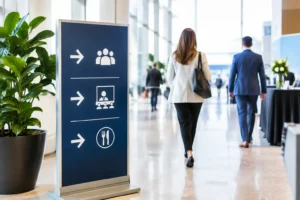
The best display package depends on your footprint, your audience, and how often you exhibit. A company attending one local event may need a simple setup with a retractable banner, table cover, and brochures. A brand exhibiting at a major convention may need a full back wall, hanging signs, mounted panels, directional signage, and matching collateral ready for multiple staff members.
This is where it helps to think beyond the booth rendering. Ask how the graphics will be packed, transported, assembled, cleaned, and reused. Some materials look excellent for one event but are less practical for repeated shipping. Others are ideal for quick installation but may not have the premium feel a high-end brand wants. There is no single correct choice. It depends on your event schedule, budget, and brand standards.
Large-format pieces set the tone
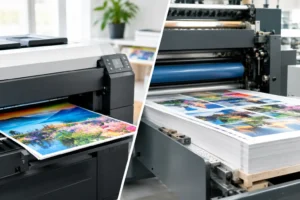
Your largest printed surfaces carry the heaviest visual load. Backdrops, tension fabric displays, adhesive wall graphics, mounted boards, and oversized posters create the first impression. These pieces need crisp output at scale, strong color accuracy, and enough contrast to read from a distance.
A common mistake is designing these graphics like a flyer. Small text blocks, crowded icons, and dense paragraphs do not translate well in a busy hall. Large-format graphics should lead with brand recognition, a clear value statement, and strong visuals that read quickly.
Supporting print closes the gap
Once someone steps into your space, smaller printed materials take over. Brochures, sell sheets, postcards, business cards, product sheets, stickers, and sign-up cards help move a conversation forward. They also reinforce the credibility of the booth itself. If your display looks premium but your handouts feel rushed, people notice.
That is why consistency matters. Paper stocks, coatings, colors, and messaging should support the same brand impression your main display creates.
Design choices that affect results on the show floor
Good trade show graphics are usually simpler than clients expect. You do not need to tell your full company story on the back wall. You need to communicate enough that the right attendee understands, within seconds, why they should stop.
Start with hierarchy. Your company name or logo should be visible, but the main message should do more than restate the name. A short statement about what you provide, who you help, or what problem you solve is usually more useful than a generic slogan.
Then consider distance. What reads well from ten feet away often fails at twenty feet. Headlines need room. Visuals need scale. Calls to action should be clear and limited. One strong message beats five competing ones.
Color also deserves more attention than it usually gets. Trade show lighting is inconsistent. Some halls wash out pale tones, while others deepen dark backgrounds and make smaller text harder to read. Brand colors should remain recognizable, but practical contrast is what protects legibility.
Photos and product imagery matter too. Low-resolution art can look acceptable on a laptop screen and still fail badly in print. Before production, image quality needs to be checked at final size, not just on a reduced proof.
Why turnaround time matters more than most exhibitors expect
Trade show deadlines rarely move in a straight line. Booth numbers change. Copy gets revised after approval. A sponsor logo is added late. Shipping gets delayed. Someone discovers a sizing issue after the graphics were already prepared.
That is why fast, dependable production is not just a convenience. It is part of event risk management. When you are exhibiting in Las Vegas, local access and responsive service can make the difference between a smooth setup and a rushed workaround.
Rush production does come with trade-offs. The shorter the timeline, the less room there is for redesign cycles, material changes, or multiple proof rounds. If you know your project may evolve, it helps to work with a printer that can guide file setup early and flag possible issues before they become expensive.
For exhibitors near the Strip and convention centers, local print support is especially valuable when replacement materials are needed during event week. A damaged banner, missing sign, or last-minute counter graphic can disrupt the whole presentation if there is no nearby production option.
Common problems in trade show display printing
Most event print issues are preventable, but only if they are caught before press time. The biggest problem is unclear sizing. A graphic built to approximate dimensions can fail when matched to exact display hardware. Another common issue is safe area misuse, where logos or text sit too close to edges, seams, or folds.
Color mismatch is another frequent headache. Brand colors can shift across substrates and finishes. Fabric, vinyl, rigid boards, and coated paper do not all reproduce the same way. If color precision matters, that should be discussed before production, not after installation.
Finishing details matter as well. Grommets, hems, pole pockets, lamination, mounting, trimming, and packaging all affect how the piece performs onsite. A banner may print beautifully and still be wrong for the display stand if the finishing is off.
Proofing should not be treated as a formality. It is the final opportunity to catch spelling mistakes, outdated dates, incorrect booth numbers, pixelated images, and alignment problems. When time is short, people rush this step. That is usually when errors survive to the show floor.
How to prepare your files for a better result
The smoother the prep, the smoother the production. Final dimensions should be confirmed against actual hardware specs. Bleed and safe margins should be built correctly. Fonts should be embedded or outlined. Images should be high enough resolution for the finished size. If multiple items are part of the booth package, file names should be organized clearly so nothing gets confused during output.
It also helps to think in terms of a full event kit rather than isolated pieces. If your team needs banner stands, sales sheets, promotional cards, and branded signage, submit those components with a coordinated timeline. That gives production a clearer picture of the job and reduces the chance of mismatch across materials.
For companies working under pressure, hands-on support is often just as valuable as the print itself. A reliable provider can help spot setup issues, recommend substrates based on use, and keep a project moving when deadlines tighten. That is especially important for convention work, where there is usually no extra day available if something goes wrong.
A smarter approach for exhibitors in Las Vegas
Las Vegas events create a unique level of urgency. National trade shows, hotel activations, pop-up exhibits, and industry conventions all compress production schedules. Many exhibitors are coordinating booth builds, staffing, shipping, and marketing at the same time. Print needs become urgent fast.
That is where a local, production-focused partner can save time and reduce risk. Design One Printing supports exhibitors and businesses that need display graphics, event signage, and marketing materials produced accurately and quickly, without adding unnecessary delays to an already tight schedule.
The best trade show display printing does not call attention to the printing process. It simply helps your booth look ready, your team feel prepared, and your brand show up the way it should when the doors open.