A strong neighborhood mailing starts before the postcard goes to press. This guide to EDDM routes helps Las Vegas businesses turn a local promotion into a targeted, measurable mail campaign without building or buying a residential mailing list. Whether you are filling seats for an event, promoting a restaurant special, opening a retail location, or generating service calls, route selection determines who sees your offer and how efficiently your budget is used.
Every Door Direct Mail, commonly called EDDM, allows businesses to mail a printed piece to every eligible residential or business delivery address within selected USPS carrier routes. Instead of addressing each postcard individually, you choose geographic routes, prepare the mailing in USPS-approved bundles, and pay postage by piece. It is a practical option when your ideal customers live, work, or make buying decisions within a defined area.
What EDDM Routes Actually Represent
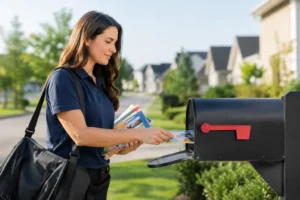
An EDDM route is a USPS carrier route, which is the group of addresses served by one mail carrier during delivery. A route can include a few hundred addresses or substantially more, depending on the neighborhood, density, and delivery pattern. That distinction matters because EDDM does not let you choose individual houses. You are selecting the entire available route.
For a local business, that can be an advantage. A plumbing company can place an offer in communities surrounding a service territory. A gym can reach homes within a short drive of its location. A convention exhibitor with a local consumer offer can create awareness before or after an event. The objective is not precision at the single-household level. It is consistent visibility across the neighborhoods most likely to respond.
USPS route tools provide estimated delivery counts and available demographic filters, such as household income, age range, or household size. These filters are useful for narrowing options, but they should support business judgment, not replace it. A route near a new housing development may be a better fit for a home-services company than a route that looks similar on a demographic report. Location, offer, driving distance, and local competition still matter.
Guide to EDDM Routes: Start With Your Service Area
Start with the area you can serve well. For many Las Vegas businesses, that may mean a radius around a storefront, a cluster of communities near a service zone, or neighborhoods along a regular delivery route. If your staff can only handle 30 new appointments per week, mailing every possible route at once can create more demand than your operation can support.
Draw a practical boundary before reviewing routes. Consider travel time, delivery capacity, minimum order values, and the type of customer you want. A carpet cleaner may focus on owner-occupied neighborhoods with larger homes. A quick-service restaurant may prioritize nearby apartment communities and office-adjacent residential areas. A business offering premium remodeling may choose fewer routes with stronger household-income alignment.
Then compare adjacent routes instead of treating every boundary as meaningful. Carrier-route lines are operational postal boundaries, not necessarily neighborhood boundaries. If one side of a major road has a different housing type, income profile, or shopping pattern, splitting your campaign may make sense. If two adjoining routes serve the same community, mailing both can provide better coverage and reduce the chance that your promotion feels scattered.
Match the Route to the Offer
The best route is tied to a specific offer, not just a desire to reach more households. Before selecting delivery areas, answer three questions: What action do you want recipients to take? Why should they act now? Can your business fulfill the response quickly?
A time-sensitive offer works well for EDDM because the mailer is physically present in the home. Restaurant grand openings, seasonal service promotions, neighborhood retail coupons, election outreach, and community event announcements all benefit from a clear deadline. For higher-consideration services, the postcard may instead offer a free estimate, consultation, showroom visit, or QR code that leads to a focused landing page.
Do not force a broad message onto a highly local campaign. “Serving Las Vegas” is less persuasive than “$25 off AC maintenance for homes in Summerlin” when the mailing is limited to that area. The more the headline, image, and call to action reflect the recipient’s likely need, the more purposeful the piece feels.
Choose a Mail Piece That Gets Noticed
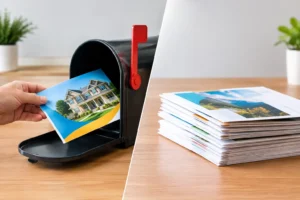
EDDM has USPS size requirements, so production should be planned around an approved format. Flat-size postcards are commonly used because they offer enough space for an offer, strong photography, contact information, and required mailing indicia while remaining easy to handle. Larger formats can create more visual impact, but they also increase print and postage costs.
The right size depends on the message. A simple coupon for a nearby restaurant can work on a smaller flat with a bold offer. A real estate team, home improvement company, or medical practice may benefit from a larger piece that can show credentials, service categories, before-and-after images, or a map. If the creative becomes crowded, changing the format is usually better than shrinking every line of text.
Design should prioritize the recipient’s first five seconds. Lead with one offer or benefit, use a visible phone number and web address, and make the next step obvious. Avoid treating the postcard like a brochure. A strong EDDM piece has one job: earn attention and create a response.
For businesses facing a short event or promotion deadline, print planning matters as much as the design. Verify the final mail date, USPS drop-off requirements, and time needed for bundling before approving production. Fast turnaround is valuable, but it cannot recover days lost to late route selection or incomplete artwork.
Prepare the Mailing Correctly
EDDM mail is delivered through a USPS retail location or a qualifying business-mail process, depending on the campaign. The mail pieces must be bundled by route, faced in the correct direction, and accompanied by the required paperwork. The delivery address area, postage marking, and EDDM indicia must also meet USPS specifications.
This is where many first-time mailers lose time. A beautiful postcard can still be delayed if the piece is the wrong size, the bundle count is incorrect, or the mailing paperwork does not match the selected routes. Confirm requirements before printing the full quantity, especially if you are using an unusual size, a folded format, or variable versions of the same campaign.
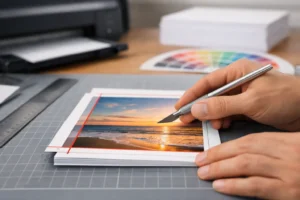
A professional print partner can help verify print specifications, prepare route quantities, produce the mailer, and keep the job moving on a compressed timeline. At Design One Printing, that hands-on production support is especially useful for Las Vegas businesses balancing promotions, events, and last-minute marketing needs.
Budget for More Than Printing and Postage
EDDM is often cost-effective because it removes the expense of purchasing and maintaining a mailing list. Still, the total campaign cost includes design, printing, postage, bundling or mail preparation, and the cost of fulfilling responses. Build the budget around the number of delivery addresses in your chosen routes, then add a reasonable overage for production needs.
Do not choose routes solely because they have the lowest delivery count or the lowest total cost. A small route may be a smart test, but it may not generate enough response to evaluate the offer. Conversely, a large blanket mailing can be wasteful if the offer only applies to a narrow customer type. The best first campaign is usually large enough to produce useful data and focused enough to protect the budget.
Track Results Before the Mail Drops
EDDM works best when it is treated as a campaign, not a one-time print order. Create a way to identify the source of each response before the postcard is mailed. This can be a unique promotional code, a dedicated phone extension, a QR code, a short campaign-specific web page, or a simple question at checkout: “Did you receive our neighborhood postcard?”
Track calls, scans, appointments, redemptions, and sales by route whenever possible. If you mail several neighborhoods, use a different code or offer variation for each group. That makes it easier to see whether a response came from the message, the route, or the timing.
One mailing can generate sales, but repetition often builds stronger results. A homeowner may keep a service postcard on the refrigerator until the need becomes urgent. A local retailer may need two or three touches before a nearby household decides to visit. If the first campaign produced interest but not enough conversions, test the offer, timing, or creative before abandoning the routes entirely.
The most useful EDDM route is the one your business can serve, measure, and mail consistently. Choose neighborhoods with intent, put a clear offer in their hands, and give recipients an easy reason to contact you when they are ready.