
A trade show opens tomorrow, a sales team needs updated brochures this afternoon, or a retail promotion has changed before the first shipment arrived. In situations like these, print on demand versus inventory is not just a purchasing decision. It affects cash flow, storage, brand consistency, delivery timing, and how quickly your business can react when plans change.
For Las Vegas businesses, exhibitors, marketers, and event organizers, the right answer often depends on the job itself. A convention booth may need a fast, limited run of updated flyers. A hotel group may need thousands of consistent rack cards for ongoing use. Understanding where each approach works best helps you order with more confidence and avoid paying for materials that are outdated, unavailable, or sitting unused.
Print on Demand Versus Inventory: The Core Difference
Print on demand means producing materials when you need them, typically in the quantity needed for a current campaign, event, location, or customer request. Instead of ordering 10,000 brochures months ahead, you might order 250 for a networking event or 1,000 for an upcoming mail campaign.
Inventory printing means placing a larger order in advance and storing the finished materials until they are needed. This model is common for evergreen products such as branded envelopes, business cards for a stable team, product labels, instruction sheets, and standard sales collateral.
Neither model is automatically better. Print on demand favors flexibility and lower upfront commitment. Inventory favors unit-cost savings and immediate access to materials that do not change often. The practical question is whether the value of flexibility outweighs the savings from ordering in volume.
When Print on Demand Makes Better Business Sense
Print on demand is a strong fit when information, creative, quantities, or timing can change quickly. That is common in Las Vegas, where an event date shifts, a speaker changes, a booth assignment moves, or a promotion needs a last-minute update.
Your content changes frequently
Menus, price sheets, event schedules, promotional postcards, staffing materials, and product brochures can become outdated quickly. Ordering only what you need reduces the risk of throwing away obsolete pieces after a phone number, offer, logo, or QR code changes.
This approach is especially useful during a rebrand. Rather than discarding several boxes of collateral with an old logo, businesses can phase in new materials as departments, locations, and campaigns need them.
You need a targeted quantity
Not every project needs a large run. A real estate agent preparing for one open house, an exhibitor attending a three-day convention, or a restaurant testing a neighborhood mailer may only need a focused quantity. Smaller runs let you match the order to the opportunity rather than guessing at long-term demand.
Targeted printing also supports segmentation. A business can create different versions of a flyer for hotel guests, local residents, trade show attendees, or existing customers without committing to excessive quantities of each version.
Speed matters more than the lowest unit price
The lowest price per piece does not always produce the lowest overall cost. If a delayed shipment means a sales team arrives at an event without collateral, or if a rushed design change leaves you with unusable brochures, the apparent savings disappear quickly.
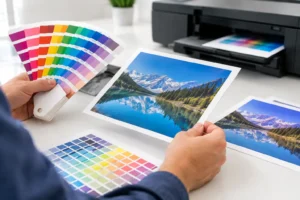
For time-sensitive campaigns, fast digital production can provide professional color, clear text, and a quick turnaround without requiring a large quantity. This is often the better choice for short-run flyers, postcards, presentation folders, posters, event signage, and replacement materials.
You want to test before committing
A new direct mail offer, package insert, or promotional design may perform differently than expected. Printing a smaller first run gives your team a chance to measure response, collect feedback, and make revisions before investing in a larger order.
When Holding Print Inventory Is the Smarter Move
Inventory becomes more attractive when a printed piece has a long shelf life, demand is reliable, and the artwork is unlikely to change. Larger production runs can reduce the cost per piece, particularly when the same item will be used steadily over time.
Your materials are truly evergreen
Some items remain useful for months or years. Standard letterhead, envelopes, branded notepads, safety labels, product packaging, and frequently used forms can be good inventory candidates if the information is stable.
The key word is stable. A brochure may look evergreen, but if it includes staff photos, pricing, service details, or dated offers, it may not be as safe to stock as it first appears.
You use predictable volume
A multi-location business that distributes 500 menus every month or a sales organization that consistently goes through presentation materials can plan ahead with greater confidence. In these cases, a larger order can lower unit costs and reduce the number of times your team needs to reorder.
Inventory also protects against supply disruptions when materials are required on a regular schedule. If a recurring event, onboarding process, or retail program depends on printed pieces, having an organized supply on hand can keep operations moving.
Consistency across locations is essential
For brands with several teams, properties, or retail locations, a single production run can help maintain color, paper stock, finishing, and messaging consistency. That consistency matters when customers encounter your brand in multiple places.
However, inventory only delivers this advantage when it is managed well. Materials should be stored in a clean, dry, accessible location, counted regularly, and issued carefully so one department does not unexpectedly use the supply intended for another.
Compare the Costs Beyond the Price Per Piece
A high-volume order usually has a lower unit cost, but that number should not make the decision alone. Consider the full cost of ownership: storage space, handling, shipping between locations, damaged materials, outdated messaging, and capital tied up in boxes of print.
For example, ordering 5,000 postcards may look economical compared with ordering 500. But if you use only 1,500 before changing the offer, the remaining 3,500 are not a bargain. On the other hand, if you know you will distribute all 5,000 within a few weeks, buying in volume can be the more efficient option.
A useful planning question is simple: How certain are we that we will use this exact piece, in this exact form, within the next three to six months? The higher the certainty, the stronger the case for inventory. The lower the certainty, the more valuable print on demand becomes.
A Hybrid Print Strategy Often Works Best
Many businesses do not need to choose one model for every item. A hybrid approach provides the practical middle ground.
Keep a supply of stable, high-use materials such as business envelopes, standard folders, core brochures, or product labels. Use on-demand production for campaign-specific inserts, event flyers, location-specific postcards, seasonal signage, updated price sheets, and materials that include time-sensitive details.
This approach is particularly effective for exhibitors. A company may keep a ready supply of branded table throws, banner stands, and general company brochures while ordering new handouts, product sheets, and promotional signage for each event. The brand stays consistent, but the messaging remains current.
Plan for Rush Jobs Without Building Excess Inventory
Rush printing is sometimes unavoidable. A shipment is delayed, a booth graphic is damaged, or a speaker hands over revised content the night before a conference. Still, a little planning can reduce the frequency and cost of emergency orders.
Keep approved source files organized, use clear version names, and identify which materials are safe to reorder without review. For recurring events, save production specifications such as final size, paper stock, finishing, and quantity history. That makes reorders faster and reduces the chance of producing an outdated version under pressure.
For projects near the Las Vegas Strip or convention centers, working with a local production partner can also change the equation. Design One Printing helps businesses move quickly from final files to finished marketing materials, signs, banners, and trade show graphics when timing is tight.
The best print strategy is the one that protects your budget without slowing down your business. Stock what you know you will use, print on demand when flexibility matters, and review your materials before each campaign so every piece in your hands still represents your brand at its best.