
A networking event can move fast. You may have 30 seconds to introduce your business, explain what you do, and give someone a reason to follow up. The best prints for networking events make that final step easy: they look professional, communicate one clear message, and stay useful after the conversation ends.
For Las Vegas professionals, exhibitors, and event organizers, printed materials also need to hold up under real conditions. They may be carried through a convention hall, placed on a cocktail table, packed into a tote bag, or handed to a decision-maker between meetings. That calls for more than simply putting a logo on paper. It calls for the right format, stock, finish, and quantity for the event you are attending.
Start With the Purpose of the Event
Before choosing a print product, decide what success looks like. A chamber mixer, recruiting event, client appreciation night, trade show reception, and large industry convention all create different opportunities.
If the goal is one-to-one introductions, a premium business card and a small service card may be enough. If you need to explain an offer or demonstrate a more involved service, a brochure or sell sheet provides the detail a card cannot. If your company is sponsoring, hosting, or exhibiting, event signage and branded display graphics help people find you before the conversation begins.
The common mistake is printing everything without a distribution plan. More pieces are not automatically better. A focused set of materials keeps your table organized, reduces waste, and gives each handout a job to do.
Best Prints for Networking Events: The Core Set
Business cards that make follow-up easier
A business card remains the most essential networking print piece because it is personal, compact, and easy to exchange. But a basic card with a name, phone number, and crowded logo is rarely memorable.
Use the front to establish your brand quickly. The back can carry a concise value statement, a short list of services, an appointment prompt, or a QR code that leads to a specific action. Keep the type readable and avoid filling every open space. A card that can be scanned in two seconds is more effective than one that tries to tell your complete company story.
For most professional settings, a sturdy cardstock with a matte or silk finish feels polished without being flashy. Gloss can make colors pop, but it may show fingerprints and can be harder to write on. A soft-touch or extra-thick stock can create a stronger first impression for premium services, although it may not be necessary for high-volume events where you expect to hand out hundreds of cards.
One-page sell sheets for clear offers
A sell sheet is one of the most practical leave-behinds for service businesses, B2B companies, and exhibitors. It gives a prospect enough information to understand your offer after the event, without requiring them to sort through a multi-page brochure.
A strong sell sheet usually includes a clear headline, the problem you solve, a few key benefits, supporting images or proof points, and direct contact information. It can also spotlight a limited event offer, a featured service package, or a new product launch.
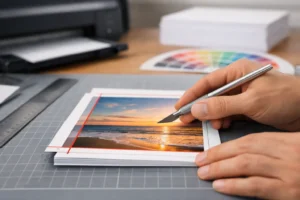
Print sell sheets on a substantial text-weight stock or a lighter cover stock, depending on the look you want. Full-color printing is usually worth the investment when photography, product images, or brand color play an important role. If your sales team will personalize these sheets with notes, a matte finish is often the better choice.
Brochures for services that need explanation
Brochures work well when your business has several service categories, a process to explain, or a story that cannot fit on one page. They are especially useful for hospitality suppliers, professional services, medical practices, real estate teams, and companies selling higher-consideration products.
A tri-fold brochure is compact and familiar, making it easy to place in a welcome bag or display rack. A bi-fold format offers larger panels and can feel more premium for visual portfolios or case-study-driven messaging. The right choice depends on how much information you truly need to include.
Do not use a brochure as a storage place for every paragraph from your website. Event attendees will skim it later, often in a hotel room or during travel. Use short sections, strong headings, and one primary call to action. If the brochure is too dense, a prospect may never reach the details that matter.
Postcards for offers, appointments, and local follow-up
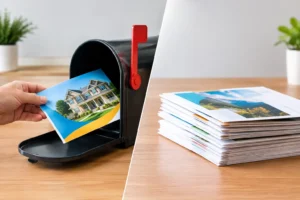
Postcards are useful when you want prospects to take a specific next step. They are ideal for event-only promotions, consultations, property tours, restaurant offers, follow-up incentives, and local service campaigns.
Unlike a brochure, a postcard is built around one message. The front should be visually immediate, while the back can hold the offer details, contact information, and a deadline. A 5-by-7-inch postcard gives you more room than a standard 4-by-6-inch piece and is easier to notice in a stack of handouts.
For networking events, consider adding a unique promo code or QR code so you can measure response. This helps distinguish event leads from other marketing efforts and gives your team a practical reason to follow up quickly.
Presentation folders for high-value conversations
When you are meeting referral partners, investors, larger clients, or scheduled appointments at an event, presentation folders can make a strong difference. They keep proposals, service sheets, rate cards, and sample materials together in a format that looks intentional.
Folders are not right for every mixer. They cost more than loose handouts and are unnecessary for casual exchanges. They are most effective when your team knows who they are meeting and can tailor the inserts to that person or company.
A branded folder also gives your material a longer shelf life. Instead of scattering across a desk, your pieces stay together until the recipient is ready to review them.
Use Signage to Start Conversations Before They Happen
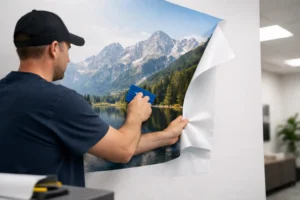
At sponsored events, check-in areas, receptions, and exhibitor spaces, signage does work that business cards cannot. A retractable banner, foam board sign, tabletop display, or branded backdrop can communicate your company name and core message from across the room.
The best event signs are simple. A passerby should understand what you offer from several feet away. Use a short headline, a recognizable logo, high-contrast colors, and one supporting visual or benefit. Small text, long mission statements, and too many product photos disappear in a busy convention environment.
For recurring networking events, retractable banners are a practical investment because they travel easily and set up quickly. Foam boards and posters are excellent for one-time events, directional signage, sponsor recognition, or last-minute additions. If you are exhibiting near the Las Vegas Strip or at a convention center, portability matters just as much as appearance. Your graphics need to move from vehicle to venue without creating extra setup stress.
Choose Finishes That Match Your Brand and Deadline
Paper choice sends a message before anyone reads a word. Uncoated stocks feel approachable and are easy to write on. Matte finishes look refined and reduce glare under event lighting. Glossy finishes add color intensity and work well for image-heavy pieces. Heavy cardstock creates a more substantial feel, but it can add cost and weight when you are ordering in volume.
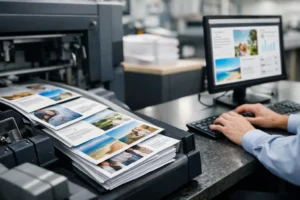
There is also a deadline trade-off. Specialty stocks, foil, embossing, die cuts, and unusual shapes can create memorable materials, but they may require additional production time. If an event is approaching quickly, a clean design on quality standard stock is usually the smarter choice than an elaborate concept that risks arriving late.
For rush orders, prioritize the pieces people will actually take and use: business cards, sell sheets, postcards, and event signage. These cover most networking needs while keeping production straightforward.
Design for the Hand-Off, Not Just the Screen
A print file can look excellent on a monitor and still fail in a crowded room. Small text becomes harder to read under dim lighting. Low-contrast colors lose clarity. QR codes that are too small may not scan. Photos can print darker than expected if they are not prepared for print production.
Give every piece one clear action. That might be booking a call, visiting a landing page, claiming an offer, requesting a quote, or connecting with a representative. Include a phone number and email when appropriate, since not every prospect wants to scan a code at the event.
If you are printing multiple materials, keep the colors, fonts, and message consistent. A business card, brochure, banner, and postcard should look like they belong to the same company. Consistency makes your brand easier to recognize when a prospect sees your material again after meeting several other businesses.
Plan Quantity and Timing Before You Arrive
Estimate quantity based on the number of expected attendees, the size of your team, and how selectively you plan to hand out materials. A room of 300 people does not always require 300 brochures. You may exchange cards with 75 people, have 40 meaningful conversations, and give detailed collateral to 20 qualified prospects.
Order enough business cards for your team plus a buffer. Bring fewer brochures or folders if they are meant for qualified leads. For table displays, pack extra postcards or one-page sheets so your space remains stocked throughout the event.
When an agenda changes, a speaker is added, or a shipment goes missing, local production support can protect the event plan. Design One Printing helps Las Vegas businesses produce polished networking materials on short timelines, including business cards, brochures, postcards, banners, signs, and custom event graphics.
Bring materials that make the next conversation easier, not just the first one possible. A well-printed card, a useful leave-behind, and a clear sign can keep your business in front of the right person long after the event floor clears.