When badge pickup starts tomorrow or a sales event opens this weekend, the right printed piece has to do more than look good. It has to get noticed, explain the offer quickly, and give people a reason to act. The best promotional print products are the ones matched to where your audience will see them, how much time they have, and what you need them to do next.
For Las Vegas businesses, exhibitors, retailers, and event organizers, that often means combining high-visibility graphics with take-home materials. A banner may bring people to the booth. A flyer, postcard, or brochure gives them the details to keep. Choosing both with a clear purpose prevents wasted print spend and creates a more consistent brand presence.
Best Promotional Print Products for Fast Results
There is no single product that works for every promotion. A restaurant launching a lunch special, a contractor building neighborhood awareness, and a convention exhibitor collecting leads have different needs. The strongest choice comes down to reach, message length, distribution method, and deadline.
Flyers for immediate offers and local outreach
Flyers work when the message is simple and time-sensitive. They are ideal for grand openings, limited-time promotions, special menus, service offers, nightclub events, and community announcements. Their single-sheet format keeps production efficient and makes them easy to hand out, place at checkout counters, include in bags, or distribute locally where permitted.
Keep the front focused on one main message. A strong headline, one featured image or offer, a deadline, and clear contact information will usually outperform a crowded page. If the offer needs terms, a menu, or additional service details, use the reverse side rather than shrinking the type on the front.
Paper selection matters here. Standard text-weight stock is practical for large-volume handouts, while a heavier gloss or matte stock gives premium promotions more presence. Gloss can make color photography pop. Matte is often easier to read under bright event lighting and is a smart option when people may write notes on the piece.
Postcards for direct mail and follow-up
Postcards are one of the most versatile promotional tools because they work in both direct mail and in-person settings. They are especially effective for retail announcements, real estate outreach, hospitality promotions, appointment reminders, seasonal campaigns, and post-event follow-up.
Unlike a folded mailer, a postcard puts the offer in plain view immediately. That makes it useful when you need a recipient to understand the message in seconds. A larger format can create more impact in the mailbox, but it also affects postage, mailing specifications, and quantity costs. The right size depends on the campaign, not simply on getting the biggest card possible.
For a mailing campaign, leave adequate room for addressing and postal requirements before finalizing the design. For event distribution, use the back for a map, QR code, discount code, or concise next step. The card should still make sense if the recipient never scans anything.
Brochures for services that require explanation
A brochure earns its place when customers need more than a quick offer. Professional services, medical practices, financial firms, hospitality businesses, home service companies, schools, and B2B exhibitors often need space to explain benefits, process, credentials, or multiple service lines.
The fold should support the way people read. A tri-fold is familiar and compact for a broad service overview. A bi-fold gives larger panels for product photos or a more premium presentation. For detailed rate cards, menus, or program information, a multi-panel format may be appropriate, but only if the information is organized clearly.
Avoid treating a brochure like a website page. Customers will not read every sentence at a busy trade show or hotel lobby. Lead with what you do, who you help, and why it matters. Then use short sections, photos, and visual hierarchy to guide readers toward a call, visit, consultation, or order.
Business cards for the moment after the conversation
Business cards remain a practical promotional product because they are personal, compact, and easy to exchange when a conversation is going well. At networking events and conventions, they provide a direct reminder of the person and company a prospect just met.
A good business card does not need to carry every detail about the business. It needs the essentials: a name, role, company, phone number, email, website, and brand identity. If space permits, add a short statement of what the company does or a specific service category. A QR code can be useful, but it should support the card, not replace readable contact details.
Heavy cardstock creates a more professional impression and holds up better in crowded wallets, badge holders, and trade show bags. Specialty finishes can be effective for luxury brands or creative businesses, although speed, budget, and readability should come first when the deadline is tight.
Banners, posters, and signs for visibility
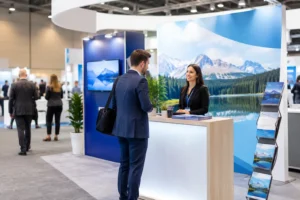
Large-format print is what makes a promotion visible from across a room, aisle, storefront, or parking area. Retractable banners are a reliable choice for booths, presentations, lobbies, and pop-up events because they set up quickly and travel well. Vinyl banners are useful for outdoor promotions, sponsor recognition, construction sites, festivals, and directional messaging. Posters and rigid signs work well for indoor displays, retail windows, easels, and event wayfinding.
Distance should determine the design. A banner viewed from 20 feet away needs a short headline, large logo, strong contrast, and one clear action. It is not the place for a full list of services or paragraphs of copy. Posters viewed at close range can carry more detail, but they still need an obvious focal point.
For outdoor signage, consider wind, mounting method, display duration, and weather exposure. For indoor convention graphics, confirm booth dimensions, venue rules, and delivery timing before production. The most polished graphic is not useful if it arrives at the wrong size or cannot be installed safely.
Stickers and labels for repeated brand exposure
Stickers and labels are smaller promotional items with a long life. They work on product packaging, takeout containers, sample bags, event giveaways, envelopes, retail purchases, and branded merchandise. They can also add a temporary promotion to existing packaging without requiring a full redesign or large production run.
Their value is repetition. A well-designed sticker puts your logo, social handle, offer, or product name in front of customers long after the initial transaction. For practical use, choose a material suited to the surface and conditions. Indoor paper labels may be sufficient for a short retail promotion, while durable vinyl is better for water bottles, outdoor use, or items handled frequently.
Build a Print Mix Around the Customer Journey
The best promotional print products usually work together. Start with the action you want: foot traffic, event attendance, leads, calls, online orders, or repeat purchases. Then select the pieces that help customers move toward that action.
For example, an exhibitor might use a retractable banner to attract attention, a one-page flyer to explain the offer, business cards for direct contact, and a postcard-sized leave-behind with a post-show incentive. A retail business may use window posters to announce a sale, counter cards to reinforce it in-store, and postcards to invite previous customers back.
Consistency is more valuable than trying to say everything on every item. Use the same logo, colors, offer language, and primary call to action across the campaign. When someone sees the banner first and the postcard later, they should immediately recognize that both came from the same business.
What to Decide Before Sending Files to Print
Fast turnaround depends on making key choices early. Confirm final quantity, finished size, paper or material, one-sided or two-sided printing, and any folding, mounting, or finishing needs. For event graphics, verify the venue deadline, installation requirements, and whether the piece must fit in a display case, shipping tube, or carry bag.
Review the artwork at full size whenever possible. Check phone numbers, dates, prices, addresses, QR codes, and logo placement carefully. A typo on a digital ad can be changed quickly. A typo on 5,000 postcards is a costly problem.
If you do not have finished artwork, involve a designer before the deadline becomes urgent. Design One Printing can help businesses turn a rough idea, existing logo, or last-minute promotion into print-ready materials without losing sight of production timing.
A promotion gets stronger when every printed piece has a job. Choose the format that fits the moment, make the message easy to absorb, and leave enough time for a final proof. That is how a stack of printed materials becomes a campaign people actually notice.