A guest who misses the parking entrance, walks to the wrong registration table, or cannot find the ballroom starts the event frustrated. Yard signs for event directions solve that problem before it reaches your check-in team. When they are clear, placed early, and printed for the conditions, directional signs keep traffic moving and give your event a more organized, professional appearance.
For Las Vegas events, that matters even more. Hotel properties, convention spaces, temporary venues, and large parking areas can be difficult to navigate, especially when several meetings or celebrations are happening at once. Directional yard signs create a practical path from the street to the final destination.
Start With the Guest Journey
The best event signage is planned around the route a first-time guest will take, not around the information your team already knows. Stand at the point where a driver or pedestrian enters the property and identify every decision they must make: where to turn, where to park, which entrance to use, and where to check in.
A useful sign sequence typically begins before the decision point. If a guest needs to turn right at the next driveway, place the sign far enough ahead for safe reaction time. A sign placed directly at the turn may be visible, but it is often too late in busy traffic or a crowded parking lot.
Think through the full route from arrival to departure. Your signs may need to direct guests to parking, accessible parking, valet, registration, the event entrance, restrooms, breakout rooms, food service, pickup areas, and exits. For a one-day conference, the simplest routes may require only a few signs. For a tournament, fundraiser, festival, or multi-room corporate meeting, a mapped sign plan prevents gaps and conflicting instructions.
Make Every Direction Easy to Read
Directional signs are operational tools, not decorative fillers. A guest should understand the message in seconds, from a vehicle or while walking through a busy area. That means keeping copy short and hierarchy obvious.
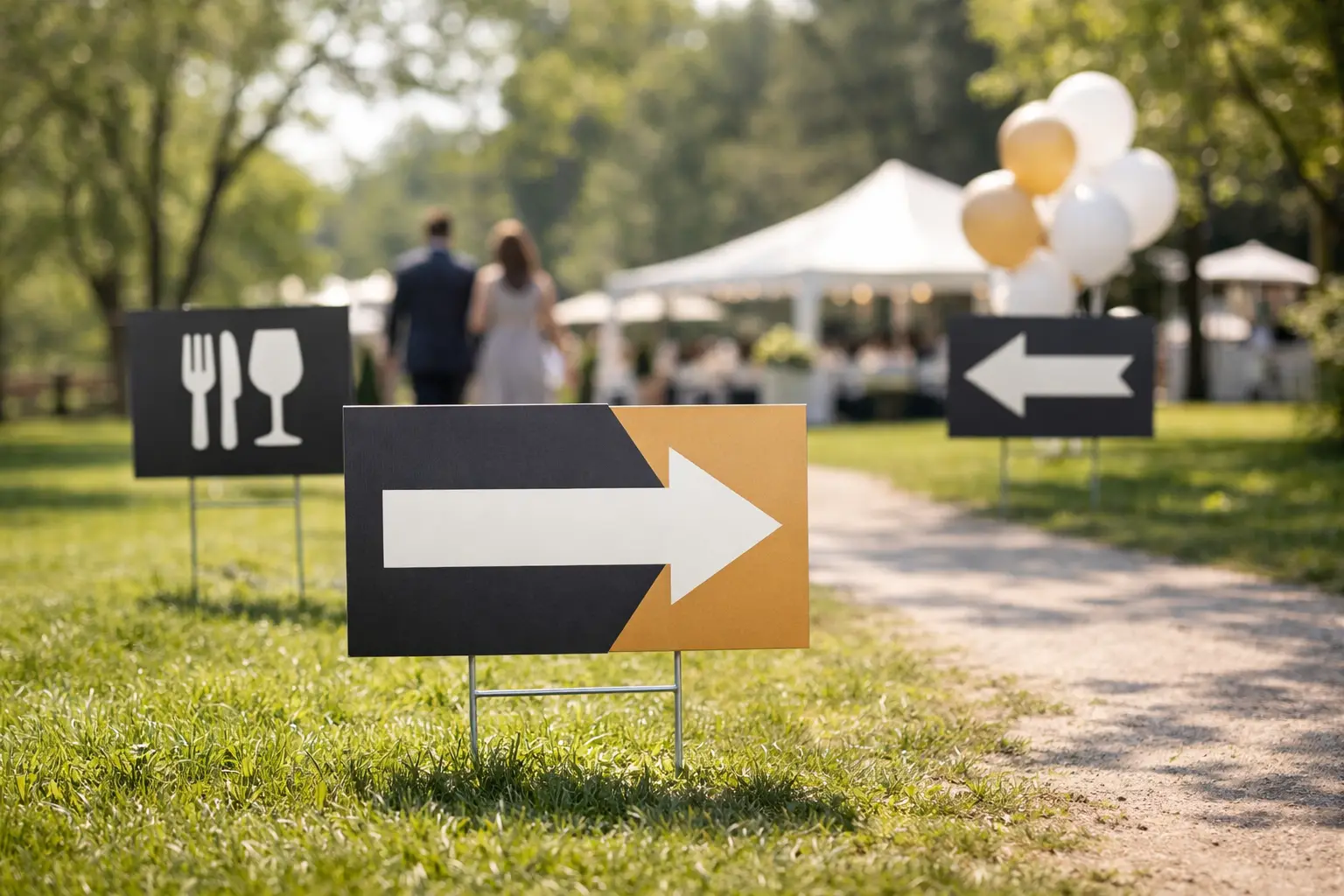
Use a large destination name, an unmistakable arrow, and only the details needed to make the next move. “EVENT PARKING →” is stronger than a full sentence explaining parking procedures. “CHECK-IN” with an arrow is more useful than placing a welcome message above the instruction.
Use arrows with purpose
Arrows deserve as much attention as the wording. Keep their size and style consistent throughout the route, and make sure the arrow points in the correct direction when the sign is installed. It sounds basic, but reversed arrows and last-minute sign placement are common causes of guest confusion.
When routes change, update every affected sign. Do not leave an old sign in place because it is technically still nearby. One incorrect arrow can send a line of cars or guests away from the event entrance.
Prioritize contrast over decoration
High contrast is what makes a sign readable at a glance. Dark lettering on a light background or light lettering on a dark background usually performs well. Brand colors can and should be included, but readability comes first.
Avoid placing small type over photographs, intricate patterns, or low-contrast colors. If your event identity includes a detailed logo, use it as a secondary visual element rather than allowing it to compete with the destination and arrow. A branded sign that cannot be read quickly does not do its job.
Choose the Right Sign Size and Material
The right size depends on viewing distance, speed of traffic, and available space. A sign that works near a registration desk will not be large enough for a parking-lot entrance. Yard signs are often used for close to mid-range directional messages, where guests need a clear instruction while entering, walking, or making a turn.
For outdoor event use, corrugated plastic signs with wire stakes are a practical choice. They are lightweight, durable, and easy to install in grass or landscaped areas. They also work well for temporary events because they can be moved as traffic conditions change.
If the venue does not allow stakes, signs may need to be mounted on weighted bases, easels, walls, fences, or other approved structures. This is where advance coordination matters. A sign plan should account for venue rules, wind exposure, irrigation, sidewalks, and the surface where each sign will be placed.
For longer viewing distances, larger rigid signs, banners, or wide-format graphics may be a better fit. Yard signs can guide guests through the final approach, while larger directional pieces identify major entrances, parking zones, or registration areas. It depends on the scale of the venue and how quickly guests are moving when they see the message.
Build a Sign System, Not a Collection of Signs
A consistent system looks more professional and reduces hesitation. Use the same color treatment, arrow style, typeface, and naming conventions across every location. If the registration area is called “Check-In” on one sign, do not call it “Welcome Desk” on the next unless there is a real difference.
Color coding can help when guests need to separate into multiple routes. A convention may use one color for exhibitor load-in, another for attendee registration, and another for VIP access. A school event may use separate colors for parking, ticketing, and activity zones. Keep the system simple enough that guests can understand it without being given a key.
Numbered signs can also help event staff manage a complicated site. For example, a route may use Parking 1, Parking 2, and Parking 3, with each location named consistently on printed instructions and digital communications. The more complex the venue, the more valuable this coordination becomes.
Plan for Placement, Weather, and Crowd Flow
Even a well-designed sign will fail if it is blocked by parked vehicles, landscaping, a tent, or a line of guests. During setup, walk the route again from the guest perspective. Check that each sign is visible at the right angle and that it does not create a safety issue near driveways or pedestrian paths.
Outdoor signs in Las Vegas also need to account for sun and wind. Bright sunlight can make weak color combinations harder to read, while wind can shift poorly secured signs. Use sturdy materials and appropriate installation methods, especially for all-day events and open parking areas.
Crowd flow is another factor. A direction that works at 8:00 a.m. may create congestion by noon if hundreds of attendees are arriving at once. For larger events, place signs at multiple points along the route so guests receive confirmation that they are heading the right way. Reassurance signs reduce last-minute lane changes and repeated questions to staff.
Order Early, but Have a Rush Plan
The best time to print directional signage is after the event route is confirmed and before the final setup rush. Early production gives you time to review spelling, test placement, and replace anything that changes with the venue plan.
Still, event details move fast. A room assignment changes, an entrance closes, or parking is redirected by the property. In those situations, local print production can make a major difference. Design One Printing helps Las Vegas businesses and event teams produce professional signs on tight timelines, including rush needs when event logistics change close to opening.
Before sending files to print, confirm the quantity of each message, arrow direction, finished size, and installation method. A simple sign inventory is useful: list each location, the sign message, the number of copies needed, and who is responsible for setup. This avoids discovering on event morning that one crucial turn has no sign at all.
Directional Signs Are Part of the Event Experience
Guests rarely praise a directional sign when it works, but they immediately notice when it is missing. Clear signage saves staff time, protects the arrival experience, and makes the entire event feel more prepared.
Treat yard signs as part of your event operations plan, not an afterthought. When the route is obvious from the first turn to the final destination, your guests can focus on why they came instead of trying to figure out where to go.