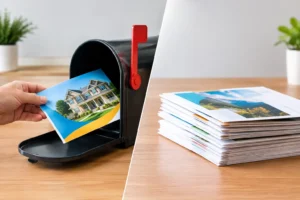
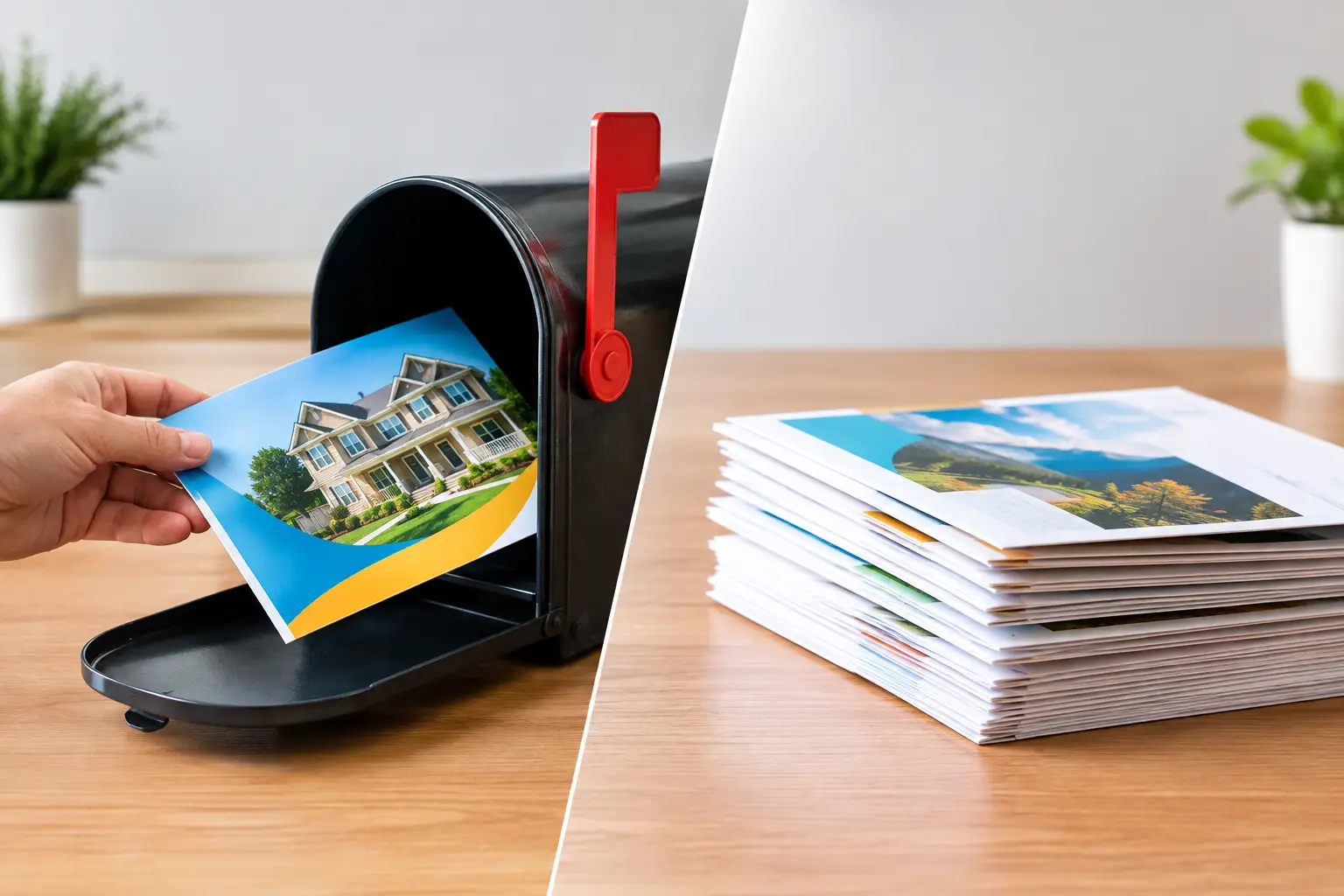
A new restaurant opening near Summerlin, a service company building routes in Henderson, and an exhibitor promoting a post-show offer may all need mailers. But they do not need the same mailing strategy. The decision between EDDM versus direct mail affects who receives your piece, what you pay, how quickly you can launch, and how clearly you can measure results.
For many Las Vegas businesses, mail still earns attention because it puts a physical offer in front of people at home or at work. The right approach is not about choosing the cheapest postage or the most detailed list. It is about matching the mailing method to the audience, offer, deadline, and response you need.
EDDM Versus Direct Mail: The Core Difference
Every Door Direct Mail, usually called EDDM, delivers a mail piece to every residential or business address along selected USPS carrier routes. You choose the neighborhoods or routes, prepare the required mailing bundles, and USPS delivers the piece without requiring individual names and addresses.
Traditional direct mail uses a specific mailing list. Your postcards, letters, or self-mailers are addressed to named people, households, businesses, or targeted prospects. The list can be built from your own customers, purchased based on demographic or geographic criteria, or created from a combination of sources.
The simplest way to view the difference is reach versus precision. EDDM casts a wide net within a defined area. Direct mail lets you make more deliberate decisions about exactly who should receive your message.
Neither option is automatically better. A neighborhood grand opening may benefit from broad route coverage. A B2B company trying to reach hotel purchasing managers, medical offices, property managers, or convention exhibitors will usually get more value from a targeted direct mail list.
When EDDM Is the Better Choice
EDDM works best when location matters more than personal data. It is especially useful for local businesses that want to establish awareness within a service area, drive foot traffic, or announce a time-sensitive promotion to nearby households.
A restaurant can mail a grand-opening coupon to surrounding carrier routes. A salon can introduce a new location. A home services company can promote seasonal maintenance in ZIP codes where it wants to add service calls. A community organization can publicize an upcoming event without the time and cost of building a detailed list.
Because EDDM does not require address labeling or a customer database, it can simplify preparation. It also makes sense when you have a strong visual offer that needs to be seen by many local residents at once. Oversized postcards are a common choice because they stand out in the mailbox and give you space for a clear offer, strong branding, a map, or a QR code.
The trade-off is that route selection is broad. A carrier route may include households that are outside your ideal customer profile. You can narrow your choices by reviewing route-level information such as household counts, income ranges, or age ranges, but you are still mailing to every delivery point within that route.
EDDM is also less personal by design. You cannot greet recipients by name or tailor the offer to a past purchase. For a first introduction or a local awareness campaign, that may be perfectly acceptable. For retention and repeat sales, it may be limiting.
When Direct Mail Delivers Better Value
Direct mail is the stronger option when your audience is specific, your offer benefits from personalization, or your mailing list has real value. A business that has collected customer addresses can use direct mail to bring back previous buyers, announce a new service, request reviews, or send an exclusive offer.
It also gives B2B marketers more control. Instead of mailing every address near the Las Vegas Convention Center, for example, a company can reach businesses by industry, job title, company size, location, or other list criteria. That matters when the product is relevant to a narrow group and broad distribution would create unnecessary waste.
Personalization can improve the relevance of the mail piece. Even a simple name, location-specific message, or customer segment offer can make a campaign feel more intentional. A gym might send different promotions to former members and new prospects. A real estate professional might tailor messaging by neighborhood. A hotel-adjacent business might target decision-makers rather than every nearby residence.
Direct mail also supports cleaner campaign tracking. You can assign unique promotional codes, personalized URLs, phone extensions, or offer versions to different audience segments. EDDM can be tracked too, particularly with route-specific offers or QR codes, but direct mail provides more granular reporting when your list data is reliable.
The trade-off is preparation. You need a usable mailing list, address hygiene, postal formatting, and a plan for returned mail or outdated records. Targeting can reduce wasted pieces, but purchased lists and data services add cost. If the list is poorly matched to your offer, precision does not help.
Cost, Timing, and Print Format Matter
Postage is only one part of the budget. Your full campaign cost includes design, printing, list acquisition or preparation, addressing, postal processing, and delivery. EDDM can be cost-effective for blanket local coverage because it avoids individualized address work and uses a simplified USPS program. Direct mail may cost more per piece, especially with personalization, but it can generate a better return when it reaches higher-value prospects.
Timing should influence the choice as much as budget. If you need to promote a store opening, local event, limited-time offer, or new service area quickly, EDDM can move from route selection to mail preparation efficiently. If you are planning a customer retention program or B2B campaign, direct mail deserves additional lead time for list review, variable data, proofing, and postal processing.
Print format changes both the cost and the response potential. Postcards are practical for simple offers, announcements, menus, and coupons. Folded self-mailers provide more room for service details, event schedules, or multiple offers. Letters can feel more personal for high-consideration services, while larger pieces can increase visibility when the offer is worth the added print and postage cost.
Do not choose a format just because it looks impressive. A high-end mailer with no clear action can underperform a straightforward postcard with a strong headline, deadline, and offer. Your piece should quickly answer three questions: What is this? Why should I care? What should I do next?
Build the Campaign Around a Clear Response
Whether you use EDDM or direct mail, the mailer needs one primary goal. Trying to promote every service, product, and social channel at once weakens the message. A restaurant may want online orders. A contractor may want estimate requests. An exhibitor may want appointments booked before a trade show. Design the piece around that single action.
A practical campaign checklist includes these four elements:
- A specific offer, such as a dollar amount, percentage, limited package, or event incentive.
- A visible deadline that gives recipients a reason to act now.
- A simple response path, such as a phone number, QR code, website address, or in-store coupon.
- A tracking method that shows which mailing, route, or audience generated the response.
For EDDM, consider using different offer codes for different route groups. This can show which neighborhoods respond best and help you refine the next drop. For direct mail, segment your list when the message or customer value differs. A former customer should not receive the same message as a prospect who has never heard of you.
Common Mistakes That Reduce Results
The most common problem is targeting too broadly without an offer that appeals to a broad audience. EDDM is not a substitute for knowing your market. If you select routes solely because they are nearby, you may reach thousands of people with little reason to respond. Start with where your best customers live, work, or travel.
Another mistake is treating the mailer as a standalone effort. Recipients may scan a QR code, search your business name, call after hours, or visit your location days later. Make sure the landing page, staff, phone routing, and in-store team are ready to handle the response. If the offer is for an event or trade show, your booth signage and handouts should match the mailer so the message carries through.
Finally, avoid last-minute design changes that compromise readability. Mailing pieces must meet postal requirements, but they also need to work at a glance. Keep essential information away from the mailing area, use a readable type size, and proof every phone number, date, address, and offer condition before production.
Choose the Mailing Method That Supports the Next Move
Choose EDDM when you need broad local visibility, have a compelling neighborhood offer, and want to reach every household or business along selected routes. Choose direct mail when the audience is defined, your list is valuable, or a targeted message can justify a higher investment per piece.
For campaigns with a short runway, the print partner matters as much as the mailing strategy. Design One Printing can help Las Vegas businesses prepare professional postcards and mail pieces that are built for clear messaging, polished presentation, and fast production timelines.
The best next step is to begin with the action you need from the recipient, then work backward to the audience, format, and delivery method. A well-timed mailer does more than fill mailboxes. It gives the right prospect a clear reason to contact your business.