A single flat flyer works when the message is simple: one offer, one date, one action. But when you need to guide someone from a quick introduction to useful details and a clear next step, a folded piece gives your message room to work. Knowing when to use folded brochures can help your business present more information without handing customers a cluttered, hard-to-read sheet.
For Las Vegas businesses, exhibitors, venues, and event organizers, that distinction matters. A brochure can explain services at a trade show, help hotel guests find local offerings, support a sales meeting, or make a direct mail campaign feel more substantial. The fold is not just a finishing choice. It determines how people encounter your content, panel by panel.
When to Use Folded Brochures Instead of Flyers
Use a folded brochure when your audience needs context before they are ready to act. A flyer is designed for fast scanning. It is ideal for a grand opening, limited-time promotion, special event, or simple announcement. A brochure is better when the customer has questions: What do you offer? Who is it for? How does it work? Why should they choose you?
A folded format is especially useful when your business has multiple services, packages, locations, product categories, or audience segments. Rather than shrinking everything into one crowded page, you can organize each subject into its own panel. The reader can start with the cover, open the piece for the main message, then turn to contact details, a map, pricing guidance, or a call to action.
This makes brochures a strong fit for professional services, medical practices, real estate teams, restaurants, hospitality businesses, schools, nonprofits, home service companies, and tourism-focused businesses. They also work well for convention exhibitors who need a leave-behind that remains useful after a busy show floor conversation.
The trade-off is that brochures require more planning than flyers. Every panel must make sense in the order it is opened, and the outside panels need to be designed around the fold. If your message truly only needs a headline, image, offer, and phone number, a flyer may be faster and more cost-effective.
Use Brochures for Sales Conversations That Need Follow-Up
A brochure earns its place when it continues the conversation after your representative leaves. During an appointment, networking event, or booth interaction, people rarely absorb every detail. They may remember the face, the product, or one benefit, but they need something organized to review later.
A well-built sales brochure can introduce your company on the cover, explain the key problem you solve inside, show core services or product options, and close with contact information and the next action. For example, a contractor might use one panel for remodeling services, another for commercial work, another for project photos, and a final panel for scheduling an estimate.
For exhibitors, this is particularly valuable. Trade show attendees collect a large volume of materials, so your brochure should not try to compete through sheer density. Give it a clear purpose. A premium product line, an overview of booth services, a venue-specific offer, or a short menu of capabilities will usually perform better than a miniature catalog.
Folded Brochures Work Well for Events and Hospitality
Events create an immediate need for organized information. Guests may need schedules, speaker details, sponsor recognition, venue maps, meal options, registration instructions, or a list of nearby services. A folded brochure keeps that information together in a format that is easy to carry and reference.
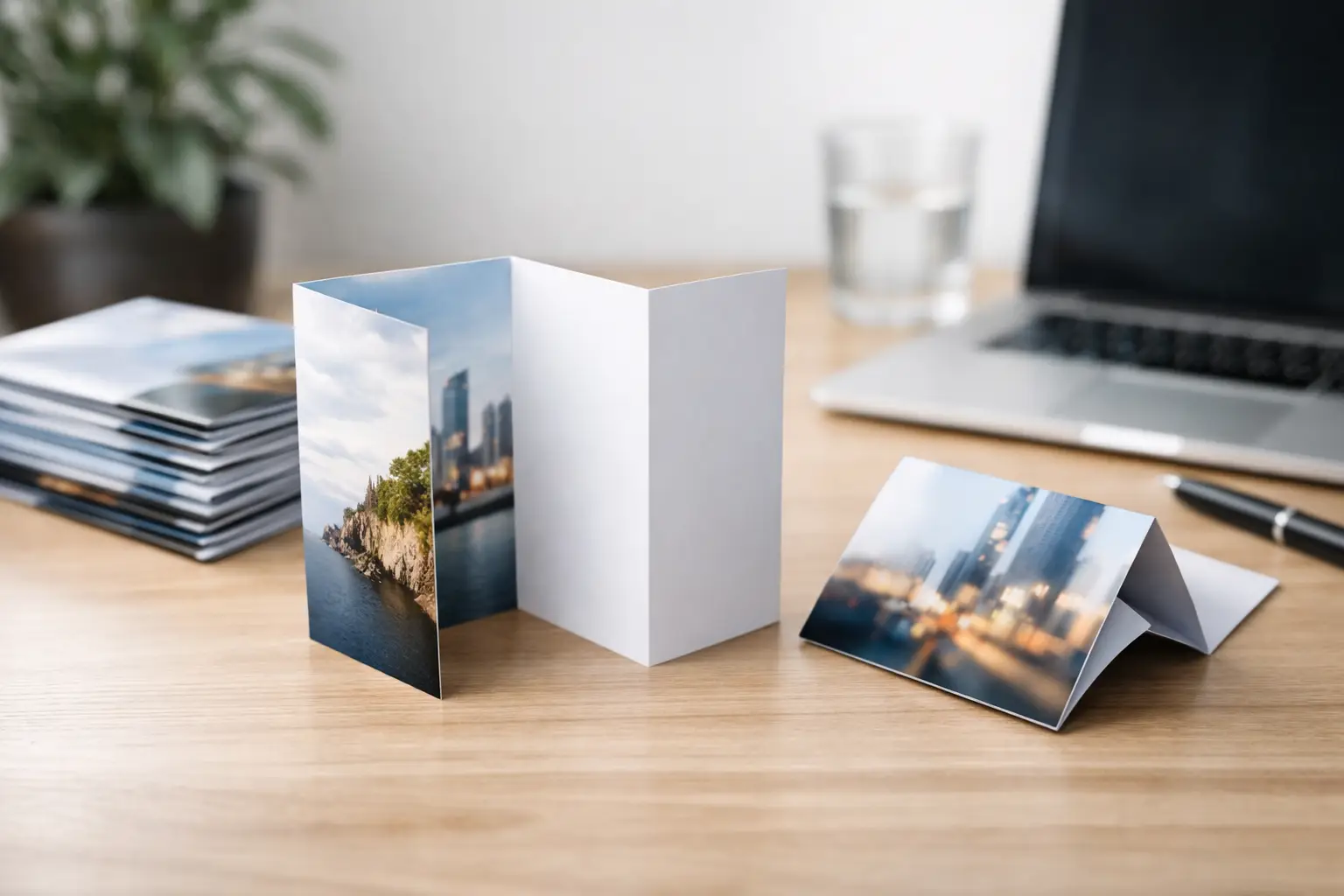
A tri-fold is a practical choice for event programs, conference handouts, property information, and visitor guides. Its narrow panels naturally create sections, which can help readers find what they need quickly. A gate fold can add impact when you want to reveal a central image, event message, or featured offer after the cover opens.
Hospitality businesses can also use folded brochures at front desks, in guest rooms, at concierge stations, or as part of local partnership programs. A restaurant group may feature locations and menus. A transportation provider may explain pickup areas and reservation options. A local attraction may use the format to show packages, hours, and directions without relying on one dense page.
For time-sensitive events, keep the design focused on information that will not become outdated overnight. If schedules, pricing, or sponsor lists are likely to change, verify the final file carefully before printing. A quick turnaround is valuable, but it cannot correct an outdated agenda after production begins.
Choosing the Right Fold for Your Message
The right fold should follow the content, not the other way around. A standard tri-fold is often the most versatile option because it provides six panels and a familiar reading experience. It works well for service overviews, menus, informational handouts, and direct mail pieces.
A half-fold, sometimes called a bi-fold, is better when you have fewer sections and want larger images or more open space. It is often a good fit for a presentation-style company overview, product launch, event invitation, or upscale hospitality piece. With four larger panels, it feels more like a compact booklet than a segmented handout.
Z-fold brochures are useful when each panel should read in sequence, such as a step-by-step process, timeline, product comparison, or list of destinations. Because the panels fold like an accordion, the piece can also be opened fully for a wide visual layout.
Gate folds create a more deliberate reveal and can make sense for high-end products, invitations, real estate presentations, and campaigns with a strong central image. They are not always the best choice for rushed informational materials, since the content structure and finishing require more attention.
Before choosing, think about what appears on the front cover, what the reader sees first after opening it, and where the final call to action belongs. Those decisions will shape the fold more effectively than simply choosing the style that looks most elaborate.
Design for Panels, Not a Flat Page
One of the most common brochure mistakes is designing the document as though it were a single poster and adding fold lines at the end. That approach can leave text crossing folds, images split awkwardly, or important details hidden on an inside flap.
Each panel should have a job. The cover should earn the open with a focused headline, relevant image, and recognizable branding. Inside panels should explain benefits, services, or choices in a logical order. The back panel is a natural home for phone numbers, email, hours, location details, QR codes, social handles, and a direct call to action.
Keep the fold area clear of small type, borders, and critical image details. Small variations can occur during folding, especially on high-volume jobs, so tight alignment near a crease may look uneven. Your printer can provide the correct panel measurements and setup guidance before you finalize the artwork.
Paper selection matters, too. Gloss stock can make product photography and color-heavy graphics stand out. Matte stock often feels more refined and is easier to write on, making it useful for appointment notes, menus, and service materials. Heavier paper adds perceived value, though it may not be necessary for a high-quantity handout with a short lifespan.
Use Folded Brochures in Direct Mail When the Offer Needs Explanation
Direct mail brochures give recipients more than a discount. They give them reasons to respond. This is useful for services that require trust or a higher level of consideration, including financial planning, healthcare, home improvement, education, legal services, and business-to-business offerings.
Instead of leading with every detail, use the outer panel to establish relevance. Inside, explain the problem, introduce your solution, provide proof through testimonials or results where appropriate, and make the response path simple. A strong offer can still be part of the piece, but it should support the story rather than carry the entire campaign.
For local campaigns, geographic relevance can improve response. Mention the neighborhood, service area, event location, or nearby landmark when it is meaningful to the customer. Just avoid turning the brochure into a wall of copy. The value of the format is its ability to pace information.
Plan Production Around Your Deadline
Brochures are often needed for moments that cannot move: a convention opening, sales meeting, venue event, grand opening, or mail drop. Build in enough time for content review, design approval, proofing, printing, folding, and delivery or pickup. If the piece includes variable data, mailing addresses, or multiple versions, allow additional review time.
When the deadline is tight, simplify the decision-making. Finalize the fold, quantity, paper preference, and artwork early. Confirm that contact information, dates, booth numbers, and offer language are correct before the job goes to print. A clean, well-organized file helps a production team move quickly without sacrificing the details that customers notice.
For Las Vegas businesses and exhibitors working against the clock, Design One Printing can help assess whether a folded brochure is the right format, prepare the artwork for production, and produce professional collateral on a fast timeline. The best brochure is not the one with the most panels. It is the one that gives your customer the right information at the moment they are ready to use it.