When a deadline is tight and your printed pieces still need to look sharp, the choice between offset vs digital printing stops being theoretical. It affects turnaround time, color consistency, unit cost, and how confidently you can hand out a brochure, hang a poster, or launch a direct mail campaign on schedule.
For businesses in Las Vegas, that decision often happens fast. A convention date moves up, a sales team runs low on collateral, or a booth graphic needs to be replaced before doors open. In those situations, knowing which print method fits the job can save both time and money.
Offset vs digital printing: the core difference
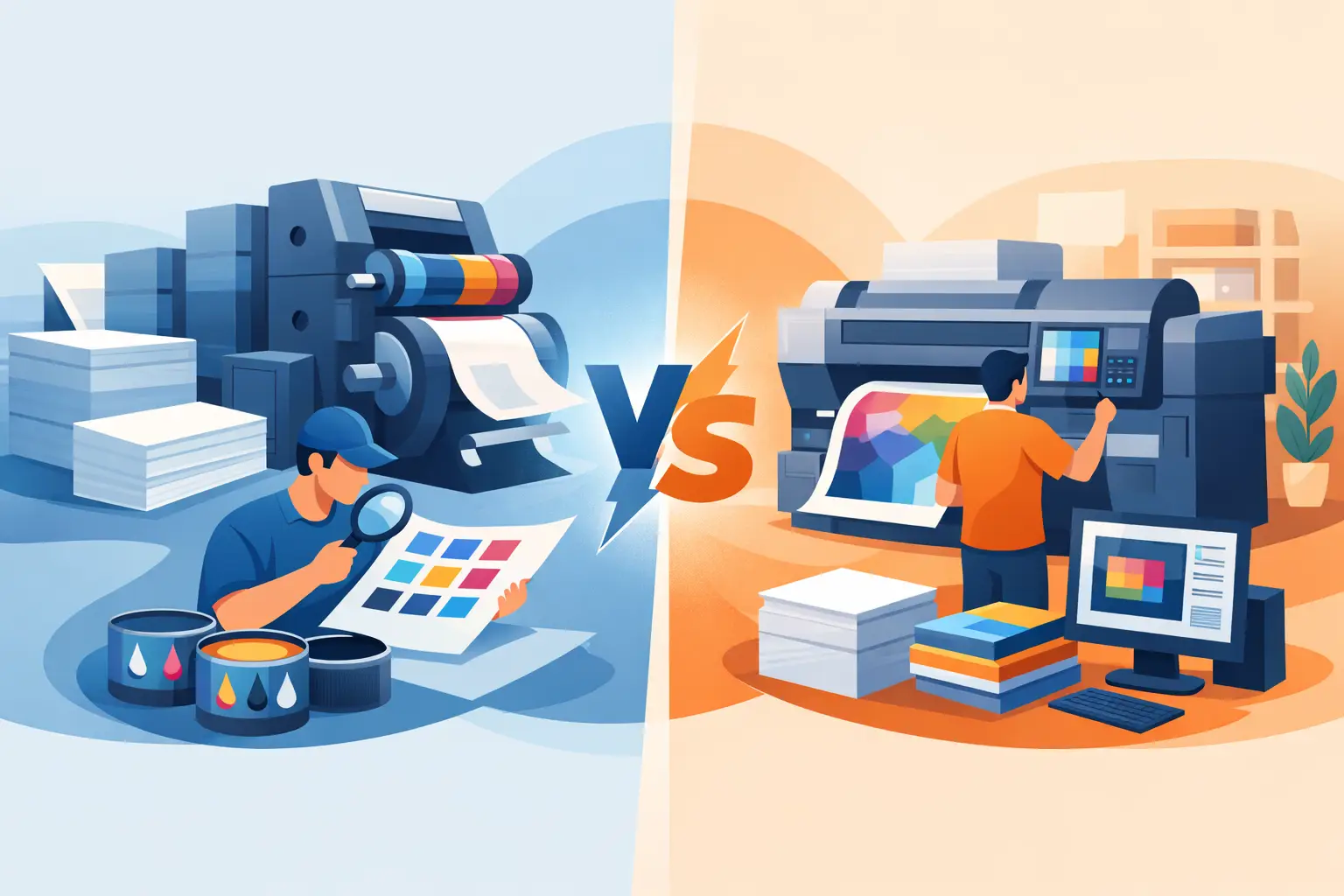
Offset printing uses metal plates and ink transferred through rollers onto paper or other substrates. It is a traditional commercial printing method built for consistency and efficiency at higher volumes. Because setup takes more time, offset makes the most sense when you are printing enough pieces to spread that setup cost across the run.
Digital printing works without plates. Files are sent directly from a computer to the press, which makes setup much faster. That speed makes digital a strong choice for short runs, quick changes, and rush jobs where timing matters as much as appearance.
Both methods can produce professional results. The better option depends on quantity, schedule, budget, and the type of piece you are printing.
When digital printing is the smarter choice
If you need materials quickly, digital printing usually has the advantage. There is less setup, fewer production steps, and faster readiness from file approval to finished product. For same-day or next-day business needs, that matters.
Digital is often the right fit for business cards, flyers, postcards, short-run brochures, presentation handouts, and event materials that need to be produced in limited quantities. It is also useful when versioning is involved. If you need multiple versions of a postcard, individualized direct mail, or last-minute edits to pricing or dates, digital production makes that easier.
The cost structure is another reason many businesses choose digital. For smaller runs, digital is typically more economical because you are not paying for plate creation and longer press setup. If you only need 100 brochures or 250 flyers, offset may deliver more capacity than you need without giving you enough cost advantage to justify the extra setup.
Digital also works well for fast-moving marketing. Restaurants testing a seasonal promotion, exhibitors updating one-sheet handouts, or local businesses printing a limited run for a weekend event can move quickly without committing to a large quantity.
That said, digital is not always the best choice for every branded piece. If color precision across thousands of copies is critical, or if the project requires specialty inks, offset may still be stronger.
When offset printing makes more sense
Offset printing earns its value when volume increases and consistency matters. Once the press is set up, the cost per piece drops significantly, which makes offset a cost-effective option for long runs. If you are printing thousands of brochures, catalogs, inserts, or direct mail pieces, offset often delivers better economies at scale.
It is also the preferred method for jobs that demand precise color matching. Brands with strict visual standards often rely on offset when they need exact reproduction of logo colors across large quantities. Pantone matching and specialty ink control are major advantages here.
Offset can also handle a broad range of paper stocks and finishing requirements with excellent image stability. For premium brochures, corporate folders, high-volume postcards, and sales collateral that need to look uniform from the first sheet to the last, offset remains a strong commercial standard.
The trade-off is time. Offset usually requires more prepress preparation, plate creation, press calibration, and production planning. If you need a rush order by tomorrow morning, offset may not be practical unless the job is already staged and simple to run.
Quality differences: are they still noticeable?
For many everyday business applications, the quality gap between offset and digital printing is much smaller than it used to be. Modern digital presses produce clean text, sharp graphics, and strong color output that works well for marketing materials, presentations, and trade show support pieces.
Still, there are differences.
Offset often provides more refined color control over long runs. Large solid areas, subtle gradients, and exact brand colors can be more predictable with offset, especially on projects where visual consistency is being closely reviewed. If a national brand is distributing 25,000 brochures, that level of control may matter.
Digital printing, on the other hand, is more than sufficient for many business needs, especially when speed and shorter quantity runs are driving the decision. A well-produced digital brochure, flyer, or postcard can look excellent in customer-facing settings. Most clients are not comparing it side by side with an offset run under production lighting. They are looking at whether it is polished, readable, on-brand, and delivered on time.
Cost depends on quantity, not just the job
One of the most common mistakes in offset vs digital printing is assuming one method is always cheaper. It is not that simple.
Digital usually wins on low quantities because setup costs are lower. Offset often wins on higher quantities because the initial setup is spread over more pieces. That means the price break happens at a certain volume, and that volume changes based on the item, sheet size, paper stock, and finishing requirements.
For example, 100 event flyers are usually a digital job. Ten thousand postcards for a regional campaign may be better suited for offset. A middle-range quantity can go either way depending on deadlines and specifications.
This is why quoting matters. The right production method is not only about equipment. It is about what gives your business the best result for the timeline and budget you are working with.
How to choose for common business print projects
Business cards are often produced digitally when speed and moderate quantities are the priority. If you need cards for a team attending a convention this week, digital is usually the practical route. For large corporate orders with strict color standards and higher volume, offset may be worth considering.
Brochures can go either direction. Short-run brochures for a sales meeting, property tour, or event handout are usually ideal for digital. A major marketing rollout with thousands of identical brochures often leans toward offset.
Postcards and direct mail pieces depend heavily on quantity and data needs. If each piece includes personalized information, digital has a clear advantage. If the design is static and the mailing volume is large, offset may lower the per-piece cost.
Posters, signs, and convention graphics are often produced through digital wide-format equipment because those projects require size flexibility, fast turnaround, and shorter run lengths. Offset generally is not the conversation for those applications.
Packaging, presentation folders, and premium collateral can go either way depending on stock, finishing, and volume. This is where an experienced print partner helps sort out the technical side before production starts.
Why turnaround often decides the job
In a market like Las Vegas, turnaround is not a side issue. It is often the deciding factor. Businesses here work around trade shows, hospitality schedules, promotional events, and replacement needs that cannot wait through a long production cycle.
That reality gives digital printing a major advantage for many local orders. If you need updated flyers after a pricing change, replacement posters before an event, or a short run of brochures for a next-day meeting, digital keeps projects moving.
Offset still has a place, especially for planned campaigns and larger print volumes, but it works best when there is enough lead time to use it properly. If your deadline is fixed and close, the smartest print method is the one that gets the piece produced correctly and on time.
At Design One Printing, that practical approach matters because customers are often balancing presentation quality with hard deadlines. The goal is not to push one method over the other. It is to match the production method to the job.
The better question is not which is best
The better question is which one is best for this job, this quantity, and this deadline.
If you need short-run marketing materials fast, digital printing is often the right call. If you need large-volume collateral with highly controlled color and lower per-piece cost at scale, offset may be the better investment. Neither method is automatically superior. Each solves a different production problem.
A good print decision comes from looking at the real use case – how many pieces you need, how quickly you need them, what paper and finish you want, and how closely the final color has to match your brand standards.
When those factors are clear, the choice between offset and digital gets much easier. And when your print provider helps you make that call early, you spend less time second-guessing production and more time getting materials into customers’ hands.