
When the expo hall opens, you usually get a few seconds to make an impression. Attendees are scanning rows of booths, comparing brands quickly, and deciding where to stop based on what they can see from a distance and what they can understand at a glance. That is why the best marketing materials for expos are not just attractive – they are built to do a job fast.
For exhibitors, the real challenge is not choosing the most materials. It is choosing the right mix. A table full of handouts can look busy without being effective, while a well-planned set of signs, printed collateral, and takeaways can bring in more traffic and support better conversations. The strongest expo materials work together to help people notice your booth, understand your offer, and remember your brand after the event.
What the best marketing materials for expos need to do
Expo materials have to perform in a high-distraction environment. People are walking, talking, checking schedules, and moving on quickly. If your materials are too detailed, too small, or too generic, they get ignored.
The best pieces usually serve one of three functions. They attract attention from across the aisle, support the sales conversation at the booth, or keep your brand in front of prospects after the show. If a printed item does not do one of those things, it may not deserve space in your booth setup.
That is also where trade-offs come in. Large visual pieces help with visibility, but they do not replace a clear handout. Brochures can explain more, but they only work if the design is easy to skim. Giveaways can extend recall, but if they are unrelated to your business, they may bring the wrong traffic.
Booth banners and large-format graphics
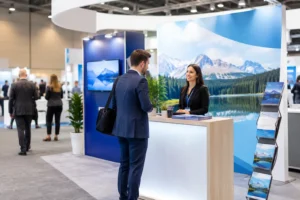
If your booth is not visible from a distance, everything else becomes harder. Banners, backdrops, mounted signs, and other large-format graphics are usually the foundation of expo visibility because they communicate your brand and your offer before anyone speaks to your team.
A strong expo banner should answer three questions immediately: who you are, what you do, and why it matters. That does not mean filling the design with copy. In fact, the opposite is usually true. A clean headline, readable brand mark, and one focused message will outperform a crowded layout almost every time.
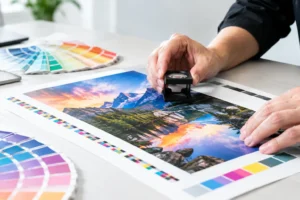
For expos, readability matters more than detail. Attendees should be able to understand the main message while walking by. If your booth graphic requires someone to stop and study it, it is doing too much. Good production quality matters too. Curling edges, dull color, or low-resolution graphics can make a strong brand look unprepared.
Brochures that support real conversations
Brochures remain one of the best marketing materials for expos because they give prospects something useful to take with them after a conversation. They work especially well when your products or services need a little more explanation than a banner can provide.
The key is keeping the brochure practical. Instead of trying to tell your full company story, focus on what a prospect needs to know next. Include your core services or products, major differentiators, contact information, and any helpful visuals that explain your process or results.
Format matters here. A tri-fold brochure is easy to display and carry, but a flat brochure or booklet can work better if you need more room for service categories, pricing structures, or event-specific offers. It depends on how much information your buyer actually needs before the next step.
Business cards still matter at expos
It is easy to assume digital contact sharing has replaced printed cards, but business cards still do important work on the expo floor. They are fast, easy to exchange, and useful when someone wants your information without carrying a full brochure.
A good expo business card should be clean, readable, and current. This is not the place for tiny type, outdated phone numbers, or crowded layouts. If multiple team members are staffing the booth, make sure everyone has enough cards and that the branding is consistent across the set.
This is also one area where print quality has an outsized effect. A sharp, well-produced business card signals professionalism in a very small format. Cheap-looking cards can undercut an otherwise polished booth.
Flyers and one-sheet handouts
Flyers are often underestimated because they are simple, but that simplicity is exactly why they work. A one-sheet can present one offer, one product line, one event special, or one clear explanation without overwhelming the reader.
For many exhibitors, a flyer is more useful than a longer brochure. If you are promoting a limited-time show discount, launching a new service, or trying to drive traffic to a demo, a one-sheet keeps the message focused. It is also easier to reprint quickly if details change before the event.
This is where fast production becomes especially valuable. Expo plans shift. Pricing updates happen. Booth numbers change. A flexible flyer is often the easiest piece to adjust on short notice without reworking your entire collateral set.
Table covers, signage, and branded booth details
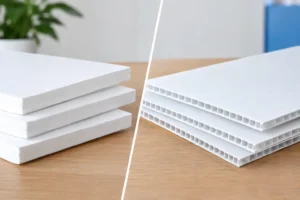
Some of the best expo materials are not handouts at all. Table throws, counter graphics, foam board signs, and directional signage help your booth look organized and complete. They also reinforce branding in ways attendees may not consciously notice but definitely register.
These details become more important in crowded convention settings where many booths are competing for attention side by side. A branded table cover can clean up the presentation instantly. Mounted signs can highlight product categories, pricing, or service benefits without forcing your team to repeat the same explanation all day.
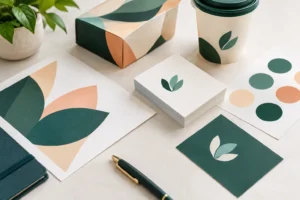
The value here is consistency. When your banners, table graphics, handouts, and business cards all look like they belong together, your brand feels more established. When each piece looks like it came from a different event, the booth can feel improvised.
Postcards and leave-behind pieces
Postcards work well at expos because they are compact, durable, and easy to distribute. They can function as mini sales sheets, appointment reminders, promo offers, or follow-up triggers. For local businesses, they are especially useful when the goal is to drive traffic after the event rather than close everything on-site.
A postcard is often more effective than a dense flyer if your message is simple. It gives you enough space for a bold headline, a strong image, and one clear next action. That might be scheduling a consultation, visiting a showroom, claiming a show special, or contacting your team after the event.
Because postcards are sturdy and easy to stack, they also hold up better in high-traffic booths. That makes them a practical choice for events where materials will be handled constantly.
Stickers, labels, and branded giveaways
Promotional items can help with recall, but only if they are chosen carefully. Attendees collect plenty of free items at expos, and many of them are forgotten by the time they get back to the hotel. If you use branded giveaways, make sure they connect to your brand and audience rather than just filling a bowl.
Stickers and labels can work well because they are low-cost, easy to distribute, and useful in the right industries. They are not right for every company, but for brands with strong visual identity or product-focused messaging, they can create a casual reminder that lasts longer than a generic handout.
The same logic applies to packaging inserts or branded sleeves if you are displaying samples. Small touches can reinforce presentation, but they should support the overall sales goal, not distract from it.
How to choose the best marketing materials for your booth
The right expo package depends on your booth size, sales process, audience, and timeline. A company with a simple service offer may do well with a banner, business cards, and one polished flyer. A business selling multiple product categories may need broader support materials such as brochures, mounted signs, and category-specific handouts.
Start with visibility first. If people cannot identify your booth quickly, your collateral will not get the chance to work. Then think about what your staff needs during conversations. Finally, choose one or two pieces attendees can take away easily.
It also helps to plan for quantity realistically. Running out of business cards halfway through day one is avoidable. So is overprinting a highly specific flyer that becomes outdated after the event. The best mix is usually the one that balances impact, flexibility, and budget.
For Las Vegas exhibitors, speed matters almost as much as design. Convention schedules move fast, shipping plans fail, and last-minute corrections are common. Working with a local print partner like Design One Printing can make a major difference when you need polished expo materials produced quickly and correctly.
A practical expo setup that works
For most exhibitors, a dependable setup includes a backdrop or retractable banner, a branded table cover, business cards, a brochure or one-sheet, and at least one simple sign that highlights the main offer. That combination covers the essentials without overcomplicating the booth.
If your team is doing appointments or demos, add postcards or flyers that make follow-up easy. If you expect heavy foot traffic, prioritize durable pieces that can be replenished quickly. If your booth is small, choose fewer materials and make each one clearer.
Expo success usually comes from clarity, not volume. The printed pieces that perform best are the ones that help people understand your business quickly and remember it later. When your materials are well designed, professionally produced, and aligned with how you actually sell, they do more than decorate a booth – they help move real business forward.
The best approach is simple: show up prepared, keep the message sharp, and bring materials that earn their place on the table.